
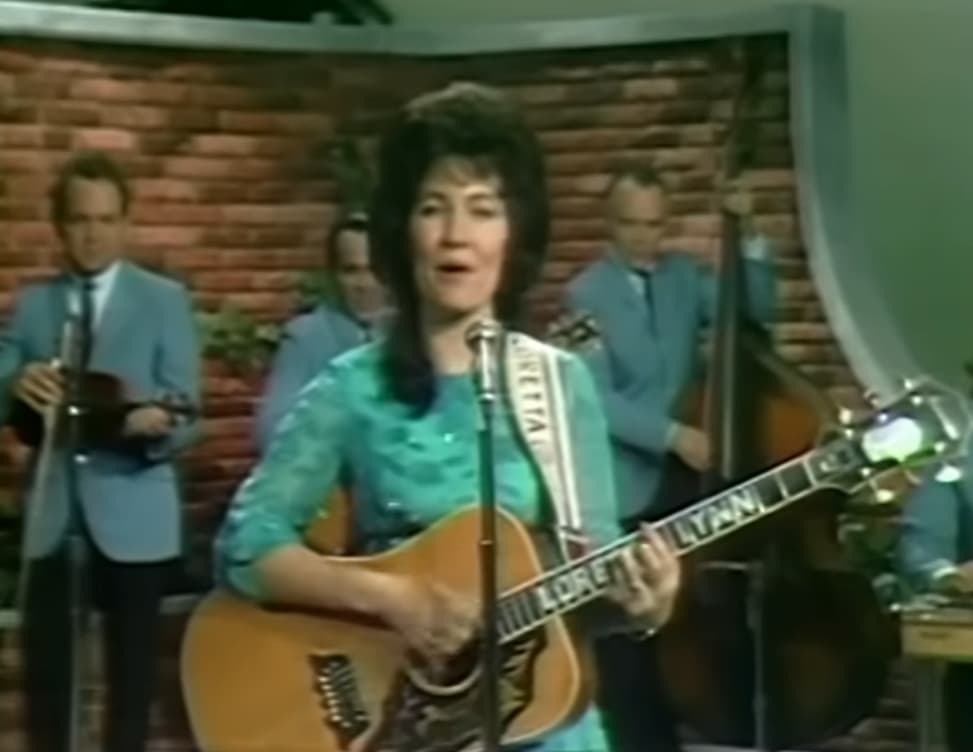
A Declaration of Strength Disguised as a Country Song
When Loretta Lynn released “You Ain’t Woman Enough (To Take My Man)” in May 1966, she was already building a reputation as one of country music’s most authentic voices. Yet this record elevated her to a new level. The single climbed to No. 2 on Billboard’s Hot Country Singles chart, becoming the biggest hit of her career up to that point, and later served as the title track of You Ain’t Woman Enough, the album that would become her first No. 1 country album.
What makes the song remarkable nearly six decades later is not simply its commercial success, but the fearless personality at its core. Country music in the mid-1960s was filled with songs about heartbreak, betrayal, and longing, yet Loretta Lynn approached the familiar subject of romantic rivalry from an entirely different angle. Instead of pleading, grieving, or surrendering, she stood her ground. The song is not a conversation with the man in question—it is a direct challenge to the woman attempting to take him away.
The inspiration came from a real-life encounter. Before a concert, a woman reportedly told Lynn about another woman trying to steal her husband. Loretta’s spontaneous response—“She ain’t woman enough to take your man”—became the spark that ignited the song. What could have been a fleeting remark was transformed into one of country music’s most enduring statements of confidence.
Musically, the record is rooted in classic honky-tonk tradition. Owen Bradley’s production leaves ample room for Lynn’s voice to carry the emotional weight. There is no unnecessary ornamentation, no grand theatrical gesture. Instead, the arrangement moves with the steady certainty of someone who knows exactly where she stands. Every note reinforces the song’s central message: conviction is more powerful than jealousy.
The lyrics themselves reveal an important distinction. The narrator is not merely attacking a rival; she is expressing faith in her own worth. Beneath the sharp one-liners lies a deeper confidence, a refusal to be intimidated. That emotional certainty became a hallmark of Loretta Lynn’s songwriting. Long before discussions about female empowerment became commonplace in popular culture, she was writing songs that allowed women to speak plainly, honestly, and unapologetically about their lives.
The legacy of “You Ain’t Woman Enough (To Take My Man)” extends far beyond its original chart run. It became one of Loretta Lynn’s signature recordings, influencing generations of country artists who admired her ability to combine toughness, humor, vulnerability, and truth within a song lasting barely more than two minutes. Its spirit can still be heard in countless country records that celebrate resilience rather than defeat.
Listening today, the song feels less like a warning and more like a portrait of the woman who sang it. Strong-willed, self-assured, and impossible to overlook, Loretta Lynn turned a simple country dispute into a timeless statement of identity. That is why the record endures—not because it tells us who might win the man, but because it reveals the strength of the woman who refuses to lose herself.