
A hymn of faith standing firm in a world of doubt
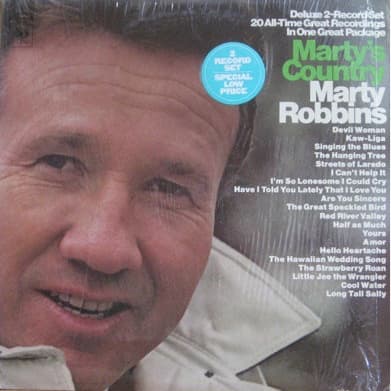
In 1965, on the album What God Has Done, Marty Robbins included his solemn rendition of The Great Speckled Bird, a song deeply rooted in American gospel and country tradition. Though Robbins’s version did not chart as a single, its presence on a dedicated gospel‑oriented record speaks to his desire to reconnect with the spiritual foundations of his musical heritage — a far cry from the dusty gunfighter ballads or the dramatic western narratives for which he is better known.
The origins of “The Great Speckled Bird” reach back to 1936, when the hymn — with lyrics by the Reverend Guy Smith — was first recorded by Roy Acuff. It became a touchstone of country‑gospel music, its simple yet haunting melody and allegorical lyrics giving voice to deep religious conviction in troubled times.
The power of Robbins’s version of “The Great Speckled Bird” lies not in chart positions but in tone and intention. At a point in his career where his repertoire had spanned cowboy ballads, pop‑country crossover hits, and dramatic story‑songs, his turn toward gospel felt neither commercial nor purely nostalgic. It felt like homecoming. On What God Has Done, Robbins offers a voice steeped in reverence, a voice attuned to humility and quiet resolution. The instrumentation is sparse, restrained — a muted guitar, gentle rhythm — serving as a humble chapel rather than a stage. Through this minimalism, every syllable of “the birds round about her” and “on the pages of God’s Holy Word” carries weight, as if spoken in candlelight rather than broadcast through neon.
Lyrically, the hymn draws on the image from the Book of Jeremiah — “mine heritage is unto me as a speckled bird, the birds round about are against her” — giving metaphorical voice to the feeling of being set apart, misunderstood, even persecuted, yet rooted in something sacred and enduring. In Robbins’s performance, the “speckled bird” becomes not just a church or institution but a symbol of personal faith and belonging — a fragile but proud emblem of conviction standing firm amid worldly storms.
It is telling that Robbins chose to place this hymn among other historic gospel standards on What God Has Done. He situates himself among a lineage of spiritual song‑writers and revivalists. This was not a detour from his career but a reaffirmation of music’s deeper purpose: to comfort, to uplift, to connect. In doing so he nods to tradition, not as museum piece but as living flame.
For listeners accustomed to the sweeping vistas and desert sunsets of Robbins’s western tunes, “The Great Speckled Bird” offers a different kind of landscape — one shaped not by canyons or gun smoke, but by faith, mortality, and the hope of transcendence. Its resonance lies in its gentleness and gravity, in its whisper rather than its roar.
In the tapestry of Robbins’s oeuvre, this hymn stands as a quiet but unshakable testament — to roots, to humility, to the enduring power of a simple song born of faith.