
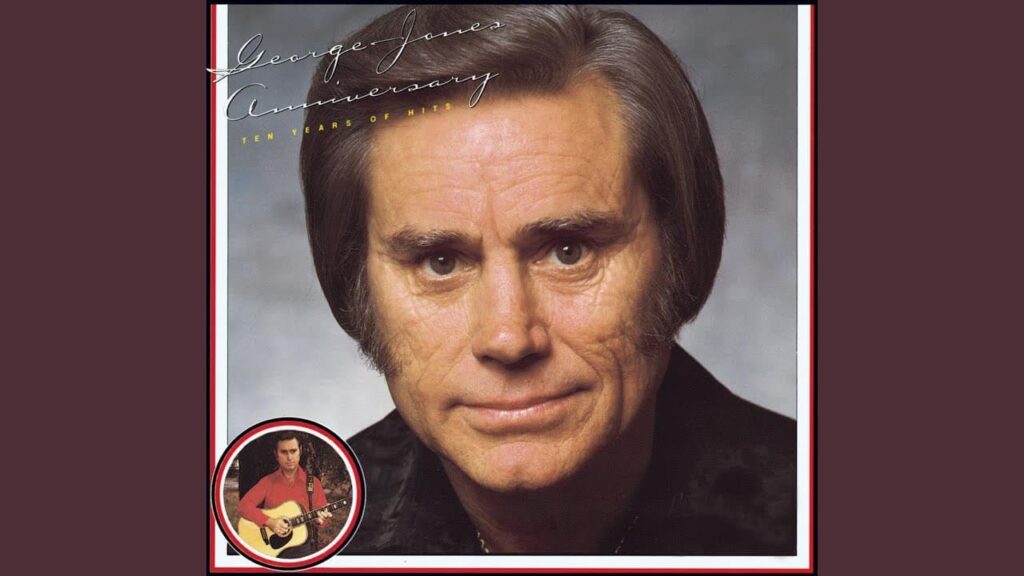
A final confession where devotion outlives pride, time, and even breath itself.
When George Jones released He Stopped Loving Her Today in 1980, the song rose to Number One on the Billboard Hot Country Singles chart and did so with a quiet inevitability that felt less like commercial success and more like moral recognition. Issued as the centerpiece of the album I Am What I Am, it marked not merely a career resurgence for Jones but a defining moment in American popular music, one that reframed what emotional truth could sound like when delivered without vanity or defense. By the time the record reached listeners, Jones was already a towering figure in country music, yet this song would come to stand apart from his vast catalog as the performance by which all others would be measured.
At its core, He Stopped Loving Her Today is not structured as a typical heartbreak song. There is no plea, no accusation, no attempt at reconciliation. Instead, it unfolds as a report, almost a eulogy delivered in hushed tones, documenting a lifelong emotional standoff that only death has the authority to resolve. The song’s brilliance lies in its restraint. The lyrics describe a man who refuses to relinquish love even after it has become socially invisible, emotionally impractical, and personally ruinous. His loyalty is not romanticized through grand gestures but preserved through quiet endurance. He keeps her letters. He keeps her photograph. He keeps his promise not to forget.
The composition reinforces this sense of solemn witness. The melody moves deliberately, allowing space between phrases as if the song itself understands the weight of what it is carrying. Strings enter not to dramatize but to dignify, lending the narrative a sense of finality that feels ceremonial rather than sentimental. Jones’s vocal performance is central to the song’s lasting power. By 1980, his voice carried the grain of lived experience, weathered and unadorned. He sings not as a participant trying to convince the listener of pain, but as someone recounting a truth so settled that it no longer needs embellishment. Each line arrives with the authority of acceptance.
What makes He Stopped Loving Her Today culturally enduring is its refusal to offer emotional escape. There is no suggestion that love heals or redeems. Love simply persists. The final revelation that he stopped loving her only because he died is delivered without dramatic pause, precisely because it does not need one. The listener is left to absorb the implication that some commitments do not seek resolution. They exist to be carried.
Within the landscape of country music, the song became a benchmark for emotional honesty, frequently cited as one of the greatest recordings in the genre’s history. Yet its reach extends beyond country. It speaks to a universal recognition that love, at its most severe, is not a feeling but a condition. Through George Jones, the song articulates a truth few records dare to state so plainly, that the deepest loves do not fade, they endure quietly until there is nothing left to endure them.