
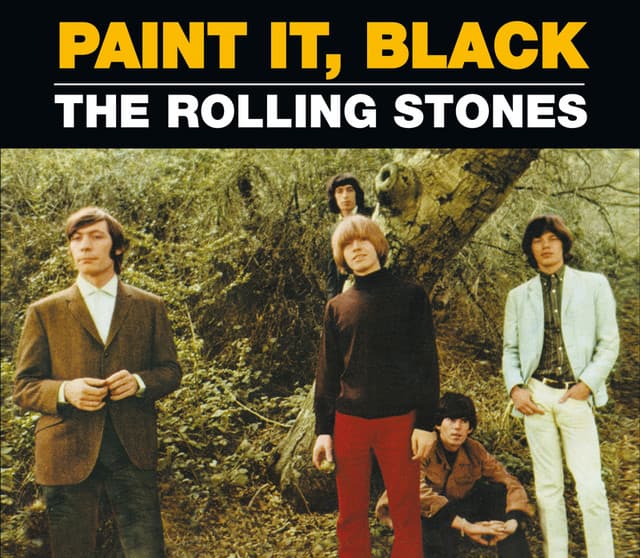
A song that turns grief into colorless defiance, transforming personal despair into a cultural thunderclap.
Released in 1966, PAINT IT, BLACK surged to number one on the Billboard Hot 100 and the UK Singles Chart, anchoring its impact within THE ROLLING STONES landmark album AFTERMATH. Appearing at a moment when popular music was shedding innocence at a startling pace, the song announced itself not merely as a hit single, but as a psychological event. It marked the Stones’ first American chart topper and signaled a decisive turn toward darker emotional territory, both for the band and for the broader language of rock music.
What distinguishes PAINT IT, BLACK is not only its commercial triumph, but the unsettling clarity of its inner world. Written primarily by MICK JAGGER and KEITH RICHARDS, the song abandons metaphorical subtlety in favor of stark emotional exposure. The narrator does not flirt with sadness. He lives inside it. Grief becomes totalizing, a force that drains the vibrancy from every object it touches. Red doors, summer clothes, bright cars, all are repainted in black as a symbolic act of control over an uncontrollable inner collapse. This is not theatrical despair. It is numbness rendered with precision.
Musically, the track was revolutionary in its time. Brian Jones’ sitar line, inspired by Indian classical music, coils through the arrangement like a persistent thought that cannot be silenced. Rather than serving as ornamentation, the sitar functions as a psychological drone, reinforcing the song’s obsessive mood. Charlie Watts’ relentless rhythm propels the listener forward with no release, while Bill Wyman’s bass and Richards’ guitar keep the structure taut and unforgiving. The song does not breathe easily. That tension is its thesis.
Lyrically, PAINT IT, BLACK stands apart from earlier expressions of heartbreak in popular music. There is no plea for reconciliation, no softening of loss. Instead, the song confronts the listener with a mind reshaped by trauma, where joy feels offensive and brightness becomes an intrusion. The famous closing lines, often misremembered as nihilistic bravado, read more accurately as resignation. The narrator is not celebrating darkness. He is surrendering to it because resistance has failed.
Culturally, the song arrived as the 1960s were fracturing under the weight of war, generational upheaval, and expanding consciousness. Without overt political commentary, PAINT IT, BLACK mirrored a growing unease that many listeners recognized instinctively. Its legacy has endured precisely because it refuses to comfort. Decades later, the song continues to resonate in films, television, and collective memory, not as nostalgia, but as an enduring document of emotional honesty.
Within the Stones’ catalog, PAINT IT, BLACK remains a turning point. It is the moment when the band proved that chart success and psychological depth were not mutually exclusive. For the listener who returns to vinyl and lets the needle fall, the song still opens like a door painted dark, not to shock, but to tell the truth about what waits inside.