
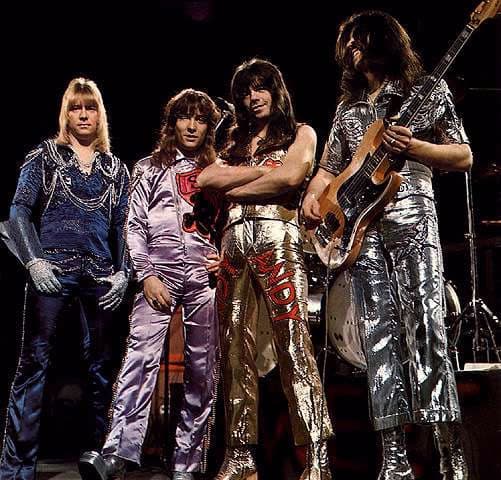
From onstage chaos to communal release, this song captures the moment when danger, glamour, and noise collide into pure rock catharsis.
Released in 1973, The Ballroom Blitz by Sweet exploded onto the charts with a force that mirrored its subject matter, reaching No. 1 in the United Kingdom and later climbing to No. 5 on the Billboard Hot 100 in the United States. It appeared on the album Desolation Boulevard, a record that crystallized the band’s transformation from glossy pop provocateurs into architects of a louder, harder sound that would ripple far beyond its era. From its opening shout to its relentless stomp, the song announced itself as both a document of lived experience and a rallying cry for audiences hungry for spectacle.
The origins of The Ballroom Blitz are rooted in a real and unsettling night. In January 1973, Sweet took the stage at the Grand Hall in Kilmarnock, Scotland, only to find themselves in a hostile environment that escalated rapidly. Bottles flew, the crowd turned volatile, and the band was forced to abandon the performance mid show. Rather than burying the incident, the group transmuted it into art, reframing fear and confusion into a narrative that pulses with adrenaline. The song does not recount the event in a literal diary sense. Instead, it distills the sensation of being surrounded by noise, threat, and exhilaration, and it turns that sensation outward, inviting the listener into the eye of the storm.
Lyrically, the song thrives on immediacy. The famous call and response structure feels less like a studio conceit and more like a crowd ritual, a way of pulling order from chaos. Questions are shouted, answers are barked back, and the effect is communal rather than confessional. This is not introspection. It is survival through volume. Musically, the track is built on a pounding piano figure and a stomp that borrows from the lineage of early rock theatrics while pushing toward something heavier. The production is crisp yet aggressive, allowing every handclap and vocal interjection to land with physical impact.
What elevates The Ballroom Blitz beyond novelty is its emotional honesty. Beneath the glitter and bravado lies an acknowledgment of how precarious live music can be, especially in an era when stages were closer to the crowd and the line between performer and audience was thin. The song captures the electricity of that proximity, the thrill and the danger intertwined. Over time, it has come to represent more than one chaotic concert. It stands as a testament to the resilience of performers who convert disruption into momentum and to the enduring power of rock music as a shared, bodily experience.
Decades on, The Ballroom Blitz endures because it remembers something essential. Music is not always born in comfort or control. Sometimes it is forged in noise, fear, and flashing lights, and sometimes the very act of turning that moment into a song is the ultimate declaration of defiance.