
A meditation on freedom that reveals how letting go can feel both exalting and terrifying at the same time.
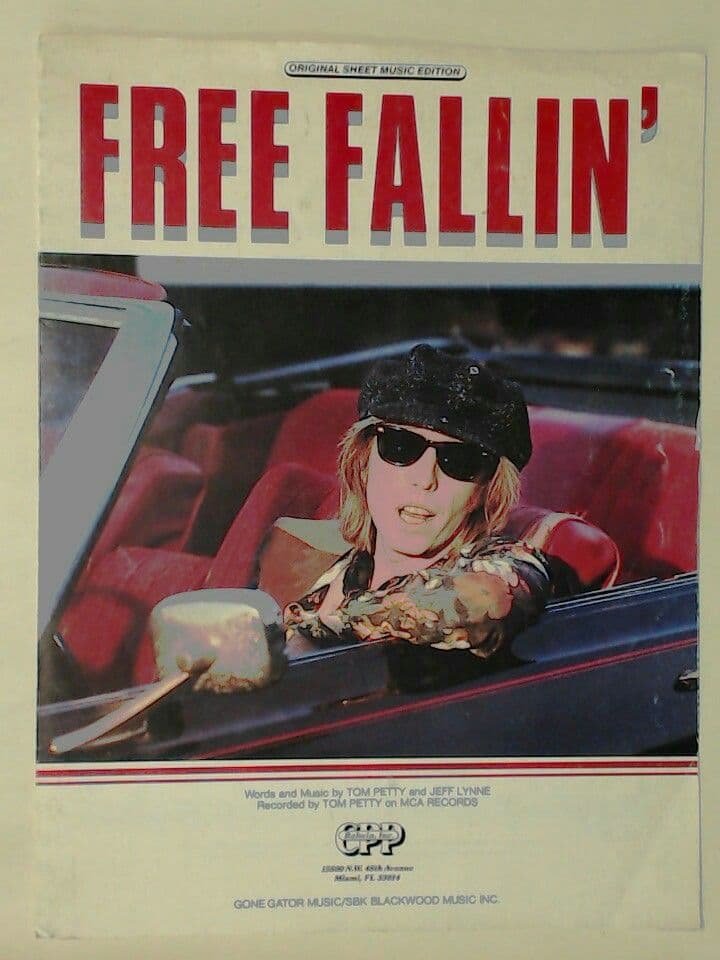
Upon its release in 1989, “Free Fallin’” climbed to No. 7 on the Billboard Hot 100, emerging as one of the defining singles from Tom Petty’s solo debut album Full Moon Fever. Though Petty was already an established American voice with the Heartbreakers, this song marked a moment of subtle reinvention. It presented him not as a bandleader driving a rock ensemble, but as a storyteller willing to let space, restraint, and vulnerability carry the weight. The commercial success was immediate, but the song’s deeper impact would unfold slowly, embedding itself into the cultural consciousness in ways that far exceeded its chart position.
At its core, “Free Fallin’” is built on simplicity. Musically, it rests on a gently cyclical chord progression that feels almost hypnotic, as if the song itself is suspended in midair. This repetition is not laziness but intent. It mirrors the lyrical state of drifting, of hovering between certainty and collapse. Jeff Lynne’s production favors clarity over bombast, allowing each element to breathe. The acoustic guitar, the steady pulse, and the unadorned vocal delivery create a sense of openness that feels both intimate and vast. There is no rush here, only the slow realization that once you step off the edge, there is no taking it back.
Lyrically, Petty paints a series of understated vignettes drawn from Southern California imagery, a landscape that often symbolizes promise and illusion in American songwriting. The girl, the boulevard, the wide sky over the Valley are not presented as romantic ideals, but as emotional coordinates. They locate the listener inside a life that looks stable from the outside yet feels quietly unmoored within. The genius of the song lies in its refusal to dramatize this condition. There is no grand confession or explosive regret. Instead, Petty offers a calm admission of emotional distance, of choices made and feelings dulled, and then frames that realization as a kind of freedom that is as frightening as it is liberating.
The refrain, repeating the act of free falling, functions less as a metaphor for escape and more as a statement of consequence. Freedom here is not triumphant. It is weightless, irreversible, and tinged with loss. Petty understood that adulthood often brings moments when release and regret arrive together, inseparable. By keeping his language plain and his melody accessible, he allowed listeners to project their own histories into the song. That is why it resonates across generations. It does not instruct or judge. It simply observes.
Over time, “Free Fallin’” has come to represent one of Tom Petty’s most enduring artistic achievements, not because it is loud or complex, but because it trusts stillness. In a career filled with defiance and resilience, this song stands apart as a quiet reckoning. It reminds us that sometimes the most honest songs are the ones that do not reach for the ground, but accept the fall and let the listener decide what it means to keep descending.