
A tender confession about love finding its way forward even when both hearts are unsure of their footing.
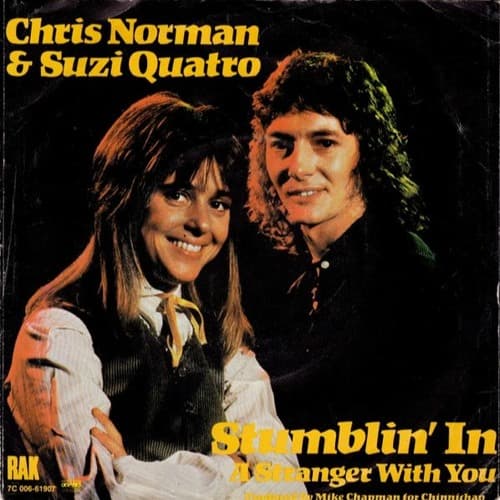
Released in 1978, Stumblin’ In became an unexpected international success, reaching number four on the US Billboard Hot 100 and the UK Singles Chart, and securing a place on Suzi Quatro’s album If You Knew Suzi…, while pairing her with Chris Norman at a pivotal moment in both artists’ careers. Though often remembered as a soft rock duet drifting gently across late seventies radio, the song arrived with remarkable commercial force, cutting through an era dominated by disco excess and arena bravado with something quieter, more human, and infinitely more durable.
At its core, Stumblin’ In is not a love song about certainty. It is a song about emotional hesitation, about two people aware of their past scars, stepping carefully toward connection without grand promises or heroic declarations. The lyrics unfold like a late night conversation rather than a proclamation. There is no sweeping romance here, only the fragile honesty of adults who have been disappointed before and are wary of believing too quickly again. That restraint is precisely what gives the song its enduring power.
The pairing of Chris Norman, fresh from his success with Smokie, and Suzi Quatro, long established as a trailblazing rock presence, created an intriguing emotional balance. Norman’s voice carries a weathered tenderness, slightly hushed, as if he is testing each word before letting it fall. Quatro responds not with dominance or theatricality, but with warmth and vulnerability, her phrasing suggesting a woman equally cautious, equally hopeful. Their voices do not compete. They lean toward one another, creating the impression of trust being built in real time.
Musically, the arrangement mirrors the song’s emotional architecture. The gentle acoustic foundation, soft percussion, and understated keyboard lines refuse to overwhelm the lyric. There is space in this recording, room for reflection, room for breath. Even the melody resists dramatic leaps, preferring a steady, conversational flow that reinforces the idea of progress made in small, careful steps. Nothing rushes. Nothing demands. The song simply unfolds.
What makes Stumblin’ In remarkable is how it frames love not as destiny, but as choice. The repeated acknowledgment of uncertainty does not weaken the bond described. Instead, it strengthens it. By admitting doubt, the singers make their connection feel earned rather than assumed. In a decade often associated with spectacle and excess, this quiet emotional realism felt almost radical.
Over time, Stumblin’ In has aged with unusual grace. It continues to resonate with listeners who recognize themselves not in youthful infatuation, but in the measured courage it takes to try again. It reminds us that some of the most meaningful relationships do not begin with fireworks, but with two voices meeting softly in the dark, agreeing to take the next step together, even if the path ahead is still uncertain.