
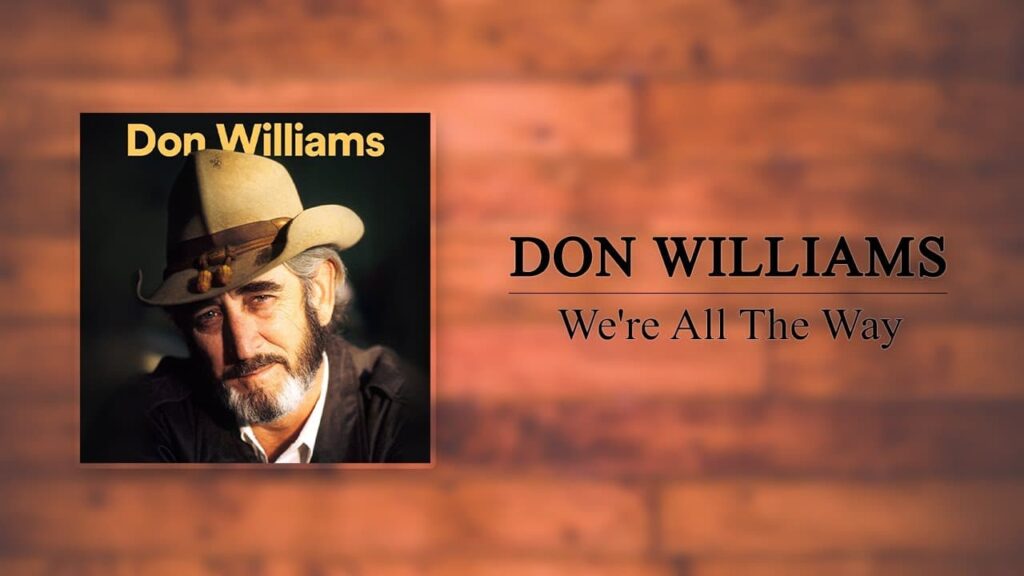
A quiet declaration of devotion that finds its power not in promises shouted, but in commitment calmly lived.
When Don Williams released We’re All the Way in 1977, the song rose steadily to the top of the Billboard Hot Country Singles chart, ultimately reaching Number One and affirming Williams’ singular place in American country music. The track appeared on his album Visions, a record that marked a period of remarkable commercial and artistic clarity for an artist already known as the Gentle Giant. At a time when country music often leaned on theatrical heartbreak or grand romantic gestures, We’re All the Way succeeded by doing the opposite, trusting restraint, emotional maturity, and an unwavering sense of emotional truth.
At its core, We’re All the Way is not a song about falling in love, but about choosing to stay there. The lyric speaks from the quiet middle of a relationship, long after the thrill of first attraction has passed, when commitment becomes a daily act rather than a dramatic vow. The narrator does not plead, boast, or dramatize his devotion. Instead, he states it plainly, with the confidence of someone who has already weathered doubt and come out the other side. That emotional posture is central to Don Williams’ enduring appeal. His songs rarely chase intensity. They earn it slowly.
Musically, the arrangement mirrors the song’s message. The production is clean and unadorned, built around gentle acoustic textures, subtle steel guitar, and Williams’ famously warm baritone. Nothing intrudes on the lyric. There is no urgency in the tempo, no attempt to manufacture tension. The calm is intentional. It reflects a relationship that has moved beyond uncertainty into something steadier and deeper. In this sense, We’re All the Way functions almost as a philosophical statement, suggesting that real love is not loud, but reliable.
The song also fits seamlessly into the broader narrative of Visions, an album that reinforced Williams’ reputation as a singer who understood emotional economy. Where many artists of the era chased crossover appeal through polished excess, Williams leaned into simplicity. His voice, unforced and intimate, sounds less like a performance and more like a conversation held late at night. That intimacy allowed listeners to project their own lives into the song, making it feel personal without ever becoming confessional.
Culturally, We’re All the Way stands as a reminder of a period in country music when emotional adulthood was not only accepted but celebrated. It spoke to listeners who recognized themselves in its quiet certainty, people who understood that love’s greatest triumph is endurance. Decades later, the song remains one of Don Williams’ defining recordings, not because it demands attention, but because it rewards it. In a genre built on storytelling, We’re All the Way tells its story by trusting silence, space, and the strength of a voice that never needed to shout to be heard.