
A communal farewell to ego and fear, where time, friendship, and acceptance meet at the edge of mortality
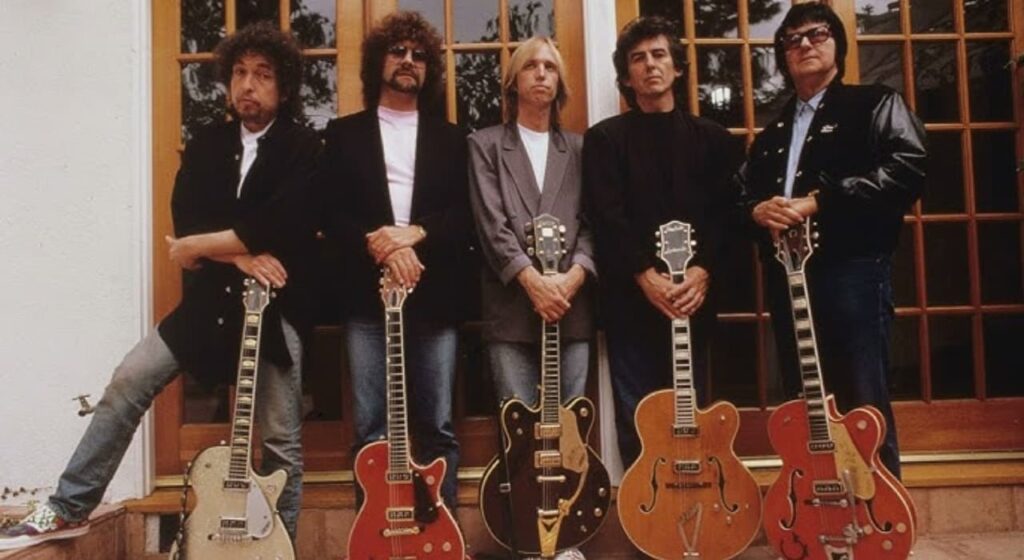
Released in 1989 as a late blooming single from Traveling Wilburys Vol. 1, End of the Line arrived quietly and then lingered. Credited to Traveling Wilburys, the unlikely supergroup of George Harrison, Bob Dylan, Tom Petty, Roy Orbison, and Jeff Lynne, the song became a Top 10 hit on U.S. rock radio, not through bombast or ambition, but through warmth and understatement. It stood as one of the final public moments of Roy Orbison’s career, lending the record a resonance that history would only deepen with time.
End of the Line is not a song about endings in the dramatic sense. There is no collapse, no reckoning, no grand moral statement. Instead, it offers something far rarer in popular music: a calm acceptance of impermanence. The lyrics unfold as a series of lived truths rather than philosophical declarations. “Well, it’s all right, even if you’re old and gray.” These lines do not console so much as affirm. Aging, loss, and uncertainty are treated not as enemies, but as fellow travelers on the road.
The genius of the song lies in its collective voice. Unlike many Wilburys tracks that clearly foreground one songwriter’s personality, End of the Line feels genuinely shared. Each voice enters not to compete, but to reassure. Tom Petty’s plainspoken warmth anchors the song in human vulnerability. George Harrison brings spiritual ease, a sense of hard earned peace shaped by years of public scrutiny and private searching. Jeff Lynne provides the melodic architecture, bright and open, while Bob Dylan’s brief appearance reminds the listener that survival itself can be an act of quiet rebellion.
Then there is Roy Orbison. His verse, soaring yet restrained, lands differently now than it did in 1989. Orbison sings of perseverance and inner resolve, unaware that this would be his last contribution to a new recording project released in his lifetime. The famous moment in the video where his chair sits empty at the end is not sentimentality. It is truth, captured without spectacle.
Musically, the song is built on simplicity. A gentle mid tempo groove, acoustic guitars, and a melody that feels instantly familiar. There is no studio excess, despite Lynne’s polished touch. Everything serves the message. This is music made by men who had already won and lost more than charts could measure.
Culturally, End of the Line has aged into something larger than a hit single. It is often cited not as a favorite Wilburys track, but as a companion piece to life itself. It plays at memorials, at reunions, at moments when words feel insufficient. For listeners who grew up with these voices, it feels like being reminded by old friends that fear is optional, kindness matters, and the journey itself was the point all along.
In the vast archive of rock history, few songs speak so gently while carrying such weight. End of the Line does not promise answers. It offers presence. And sometimes, that is everything.