
A doomed love carved into dust and gunfire, where desire outruns fate and honor demands a fatal return.
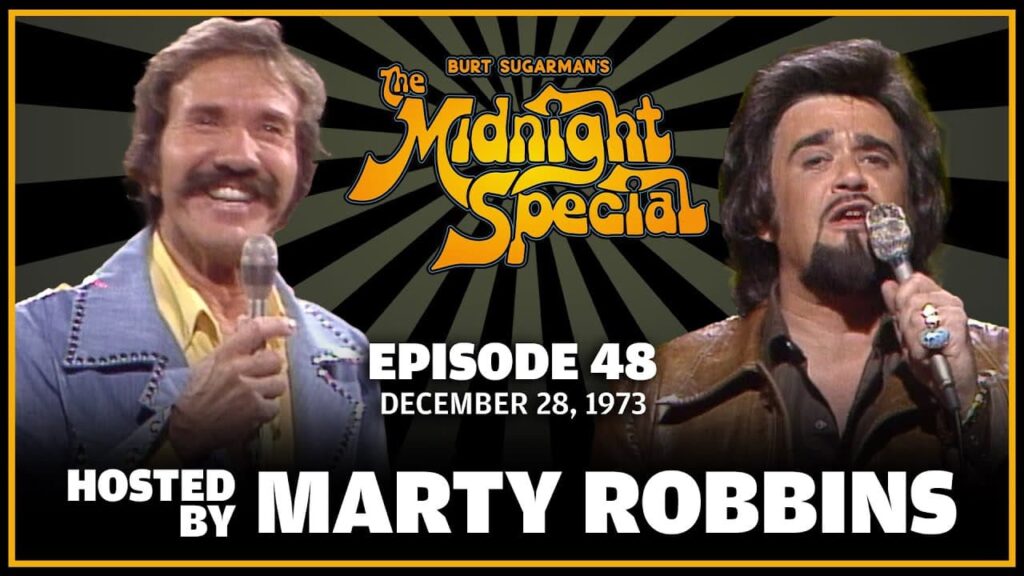
When Marty Robbins first released El Paso in late 1959, the song rose swiftly to the summit of American popular music, reaching number one on the Billboard Hot 100 in early 1960. It anchored the landmark album Gunfighter Ballads and Trail Songs, a record that reshaped the possibilities of narrative songwriting in country music. More than a decade later, Robbins would revisit this epic on national television during The Midnight Special on NBC on August 24, 1973, offering a seasoned reflection on a song that had long since escaped the boundaries of its era.
At its core, El Paso is a full novel compressed into four minutes. Robbins did not merely sing about the Old West; he inhabited it, assuming the voice of a man undone by love, jealousy, and a rigid personal code. The narrator’s obsession with Feleena is immediate and consuming, rendered in plain language that feels both intimate and mythic. When violence erupts, it is not sensationalized. It is presented as inevitable, almost ritualistic, driven by the emotional laws of the frontier rather than modern morality.
What sets El Paso apart from other story songs is its absolute commitment to consequence. There is no redemption arc softened for radio. The narrator flees, survives, and yet cannot escape the gravity of his own longing. Robbins delivers this fatal return not as a twist, but as a certainty. From the moment the song begins, destiny is already circling. The power lies in how calmly Robbins allows the tragedy to unfold, trusting the listener to follow him into the dust and silence of the final verse.
Musically, the song draws from mariachi influenced guitar figures and a rolling rhythm that mirrors both horseback movement and racing thoughts. The melody is deceptively graceful, almost comforting, which only deepens the emotional blow when the story reaches its end. Robbins’ voice remains steady throughout, never pleading, never breaking. That restraint gives the song its enduring weight. It sounds like a confession spoken too late to change anything.
By the time Robbins performed El Paso on The Midnight Special in 1973, the song had become more than a hit. It was part of the American musical vocabulary. That performance carries the quiet authority of an artist revisiting a personal myth he helped create. There is maturity in his delivery, a sense that he understands the song not just as a dramatic tale, but as a meditation on choices that define and destroy us.
Decades later, El Paso endures because it refuses to comfort. It reminds us that some loves are inseparable from ruin, and that the pull of the past can be stronger than survival itself. In the hands of Marty Robbins, the ballad becomes timeless, a whispered legend that still rides through the desert air, asking listeners whether they too would turn back, knowing the cost.