
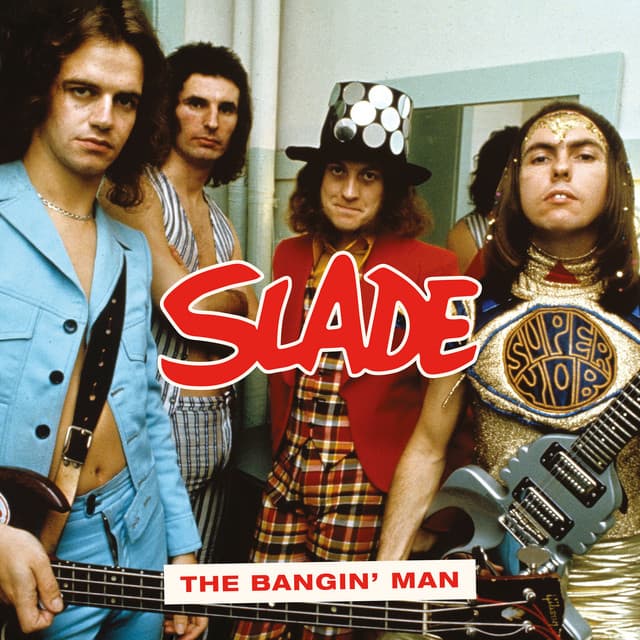
A swaggering portrait of rock stardom caught between bravado and self awareness at the height of the glam era.
Released in 1974, Slade’s The Bangin’ Man surged to No. 3 on the UK Singles Chart, arriving as a bold statement from a band already synonymous with arena sized hooks and communal roar. The song also anchored the album Old New Borrowed and Blue, a record that marked a subtle turning point for the Wolverhampton quartet as they expanded their palette beyond relentless stomp toward richer textures and sharper observation. By the time The Bangin’ Man hit the airwaves, Slade were not merely hitmakers but cultural fixtures, veterans of the glam explosion who understood both its intoxication and its cost.
At its surface, The Bangin’ Man presents itself as a raucous character sketch, all swagger, chant ready chorus, and pounding insistence. Yet beneath the foot stomping exterior lies a knowing commentary on the machinery of fame and the roles artists are expected to play. The title figure is a larger than life performer, loud, omnipresent, impossible to ignore. He is adored, pursued, mythologized. But the song’s tone carries a faint edge of irony, as if the band is winking at the listener while delivering exactly the spectacle demanded of them. This duality is central to the track’s enduring fascination.
Musically, the song leans on Slade’s proven strengths. Dave Hill’s guitar work is thick and declarative, less about finesse than impact. Don Powell’s drumming locks into a martial groove, designed to unify rather than impress. Jim Lea’s bass provides melodic muscle, while Noddy Holder’s vocal performance is the true narrative engine. Holder sings not as a detached narrator but as a man fully inhabiting the role, blurring the line between character and self. His voice carries both triumph and strain, suggesting that the performance itself is part confession.
Lyrically, The Bangin’ Man can be read as a reflection on the glam rock archetype at a moment when the genre was beginning to reckon with its own excess. Glam promised freedom through exaggeration, yet it also demanded perpetual escalation. The “bangin’” figure must always be louder, brighter, more outrageous than before. In this sense, the song captures a band looking at their own reflection in the stage lights and choosing to amplify it rather than retreat. There is honesty in that decision, and a quiet melancholy as well.
Within Old New Borrowed and Blue, the track stands as a thesis statement. The album’s title itself suggests a reckoning with past, present, and future, and The Bangin’ Man embodies the present tense urgency of a group still commanding massive audiences while sensing the ground shifting beneath their boots. Decades later, the song endures not only as a glam rock anthem but as a document of self awareness wrapped in celebration. It bangs, undeniably. But it also listens to its own echo.