
A man running hard from heartbreak learns that love, like the track, only ends when the heart gives out.
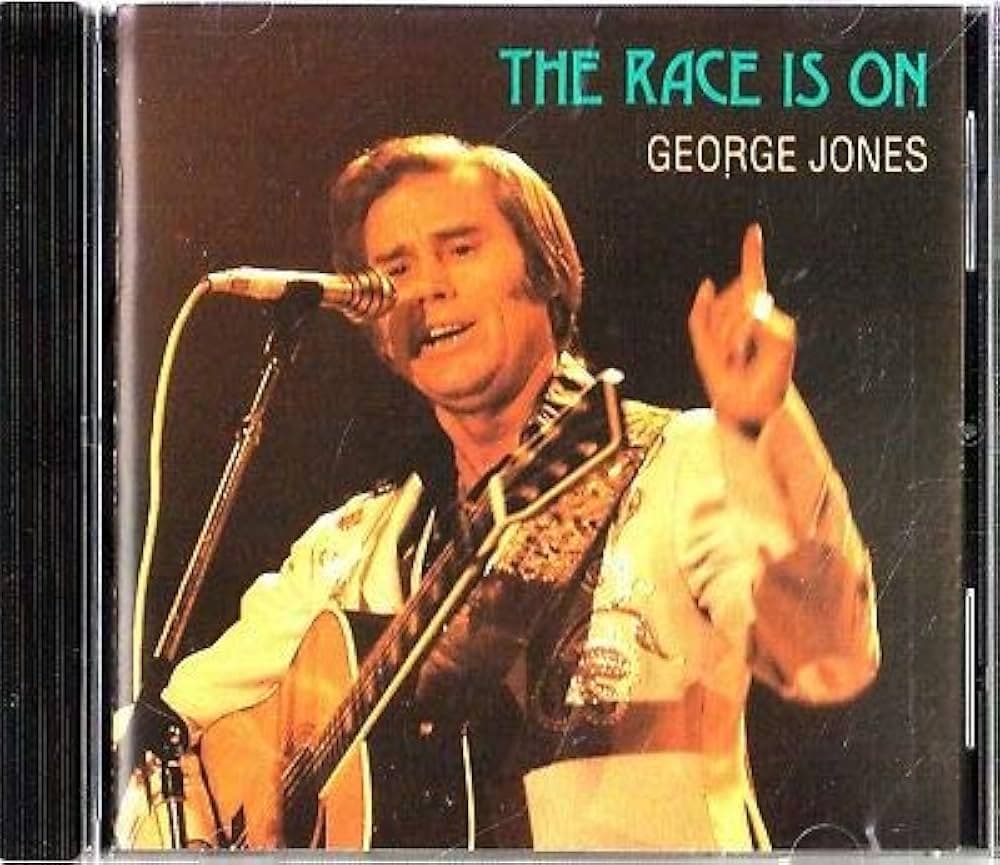
When George Jones released The Race Is On in 1964, the single surged to Number Three on the Billboard Hot Country Singles chart, confirming his command of narrative country songwriting at a time when honky tonk was sharpening its wit and speed. The song later anchored the album I Get Lonely in a Hurry, a record that captured Jones in restless motion, voice taut with urgency, band snapping at his heels. Written by Don Rollins, The Race Is On arrived as a vivid parable disguised as a toe tapping shuffle, and Jones carried it with the sly authority of a veteran who understood both the joke and the bruise beneath it.
The song opens at a sprint. Fiddle and rhythm guitar lock into a brisk cadence that evokes the clatter of hooves, while Jones enters with a grin you can hear. The central metaphor is audaciously simple. Romance becomes a day at the track. The odds are stacked. The crowd is loud. The favorite can falter. In Jones’s hands, this conceit never feels gimmicky. It becomes a framework sturdy enough to hold the contradictions of love. Confidence and dread share the same breath. Hope accelerates even as loss lurks at the rail.
Lyrically, the brilliance lies in motion. Nothing stands still. The singer is always chasing or being chased, watching the tote board of his own emotions flicker with bad news. Jones phrases the lines with a gambler’s timing, leaning into consonants, clipping vowels, letting the band pull him forward. There is humor here, but it is a hard earned humor, the kind that arrives after you have lost enough to laugh at the pattern. That balance between levity and lament is pure Jones. He can sell a punch line and a confession in the same bar, never tipping the scales too far.
Musically, The Race Is On reflects a moment when country records prized clarity and drive. The arrangement is economical, built for momentum, with the fiddle acting as both commentator and provocateur. Jones’s voice rides above it all, nasal edge softened by warmth, authority sharpened by experience. He sounds like a man who knows the rules of the game and still plays, which is the song’s quiet thesis. Love may be chance ridden and unfair, but opting out is its own kind of loss.
Culturally, the song endures because it captures a universal ritual. We return to the track even after a bad finish. We study the past performances, swear we are wiser now, and place the bet anyway. George Jones understood that cycle intimately, and The Race Is On preserves it in three relentless minutes. It is country music as lived philosophy, brisk on the surface, bruised underneath, and forever in motion, reminding us that the heart keeps running long after reason tells it to stop.