
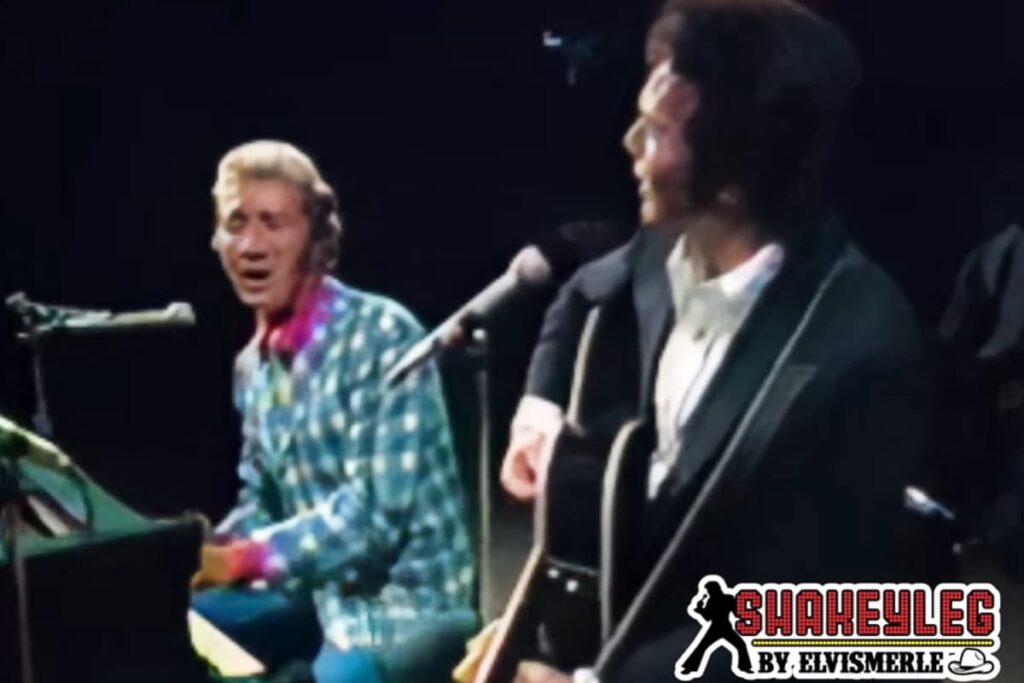
A confession whispered too late, where pride collapses and love quietly takes its place
Released in 1968, Today I Started Loving You Again became a number one hit on the Billboard Hot Country Singles chart for Merle Haggard, appearing on the album The Legend of Bonnie and Clyde, a record already steeped in outlaw mythology and emotional consequence. Though most closely identified with Haggard’s definitive recording, the song later found renewed depth through interpretations by Marty Robbins, whose own legacy of romantic fatalism made the composition feel like a shared confession passed between kindred voices. In its first life, however, the song announced itself not with bravado but with humility, an emotional reversal that resonated deeply with country audiences at the close of the 1960s.
What makes Today I Started Loving You Again endure is its almost radical simplicity. There is no dramatic twist, no clever narrative device, no attempt to win sympathy through excess detail. Instead, the song captures a single moment of emotional reckoning. The narrator does not discover love. He rediscovers it. That distinction is crucial. This is not the spark of something new but the ache of realizing what never truly died, only waited in silence. In one understated admission, Haggard gives voice to a universal human failure, the belief that distance or pride can extinguish love without consequence.
Musically, the song mirrors this emotional restraint. The melody moves with a weary grace, allowing space between phrases, as if the singer himself is choosing his words carefully, afraid of what they might cost. The steel guitar does not cry, it sighs. The rhythm does not push forward, it lingers. Everything about the arrangement suggests a man standing still while the truth finally catches up to him. This is country music as emotional realism, not melodrama.
Lyrically, the power lies in what is not said. There is no explanation for the separation, no attempt to justify past actions. The narrator accepts the moment without defense. That quiet accountability is rare in popular music, particularly in an era when heartbreak songs often leaned toward accusation. Here, the fault feels internal. Love did not leave. The singer did.
When Marty Robbins would later lend his voice to the song, he brought with him the weight of his own catalog of longing and regret. Robbins sang of doomed lovers and moral crossroads with operatic gravity, and his interpretation frames the song as a final realization rather than a tentative hope. In that sense, the song becomes less about reconciliation and more about recognition, the painful clarity that sometimes arrives only after loss has hardened into memory.
Today I Started Loving You Again remains one of the purest expressions of emotional honesty in the country canon. It does not beg for forgiveness. It does not promise change. It simply acknowledges the truth. Love, once awakened, refuses to stay buried. In that quiet admission, Merle Haggard gave country music one of its most human moments, a reminder that the hardest words to say are often the simplest, and the most devastating realization is discovering you were never finished loving someone at all.