
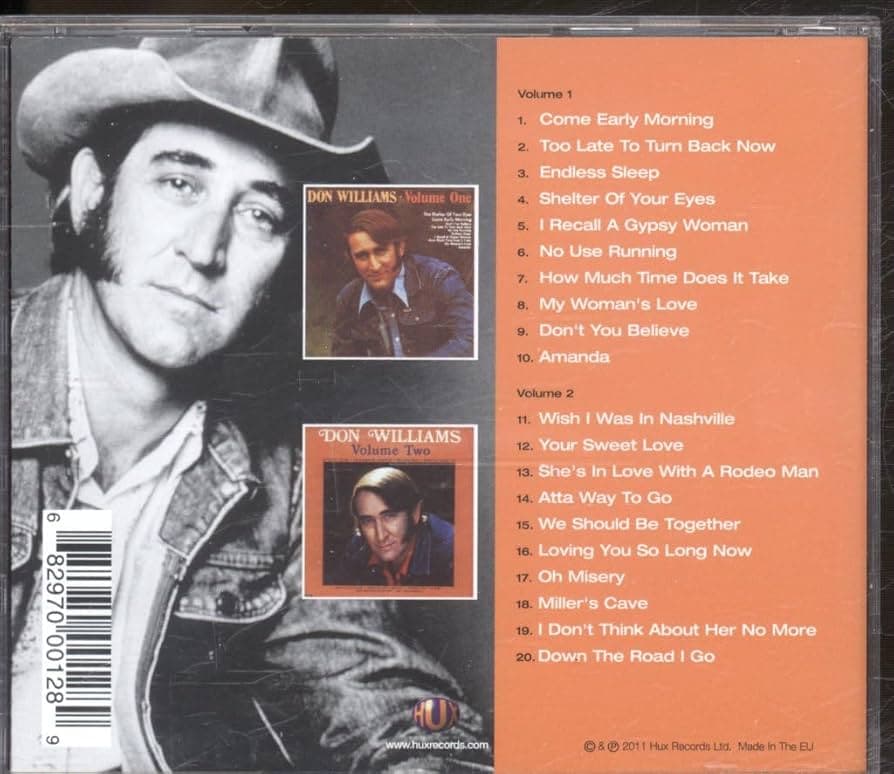
“No Use Running” encapsulates the weary grace of choosing stillness over futile escape.
In the sun-faded grooves of Don Williams’ early catalog, “No Use Running” stands as a quietly profound testament to the singer’s singular ability to weave introspective storytelling into the fabric of simple country instrumentation. Released in 1973 on his debut LP Don Williams, Volume One, the song did not chart as a single in the conventional sense that subsequent Williams classics like “I Believe In You” or “You’re My Best Friend” would. Yet its inclusion on an album that helped establish Williams’ reputation as the “Gentle Giant” of country music speaks volumes about its emotional resonance and enduring appeal among devotees of his work.
Nestled between the earnest narratives of Volume One, “No Use Running” functions less as a commercial auction and more as a philosophical waypoint. Williams wrote the song himself, opting for uncluttered arrangements that foreground his warm baritone — soft, direct, unflinching. The track unfolds in the key of C with a measured pace that mirrors its thematic terrain: a slow dawn of recognition rather than a frantic sprint toward resolution.
Lyrically, the song inhabits a landscape of emotional reckoning. Williams’ narrator stands at the metaphorical crossroads of a failing relationship, surveying the literal westward tilt of a weather vane that feels less like a direction and more like a harbinger of change. There is no dramatic breakup, no recrimination; instead, Williams offers a weary observation that becomes the song’s refrain and moral compass: “there’s no use running when you’re on the wrong road.”
This line — seemingly simple — carries the weight of lived experience. In a genre often quick to romanticize the road as a space of freedom, Williams subverts that mythos, suggesting that motion unanchored by clarity only deepens disorientation. In the verses, he unspools the remnants of conversations that “only added to the load,” a lyric that embodies the cumulative burden of unspoken yearnings and misaligned intentions.
The song’s musical humility — gentle guitar strums, spare barroom piano inflections, and Williams’ voice hovering like a calm breeze — reinforces a central paradox: that strength often resides in acceptance rather than pursuit. Within his broader catalog, where heartbreak and devotion frequently intertwine, “No Use Running” is one of the earliest exemplars of Williams’ lyrical introspection. Its legacy is not measured in chart peaks but in the quiet reflection it invites.
Decades later, listeners drawn to Williams’ Spotify streams place “No Use Running” well outside his most played repertoire — yet its modest digital footprint belies the depth of its craft and the universality of its message. In this song, Williams teaches that sometimes the most courageous act is to stop, look inward, and acknowledge that certain roads are not meant to be traveled any further.