
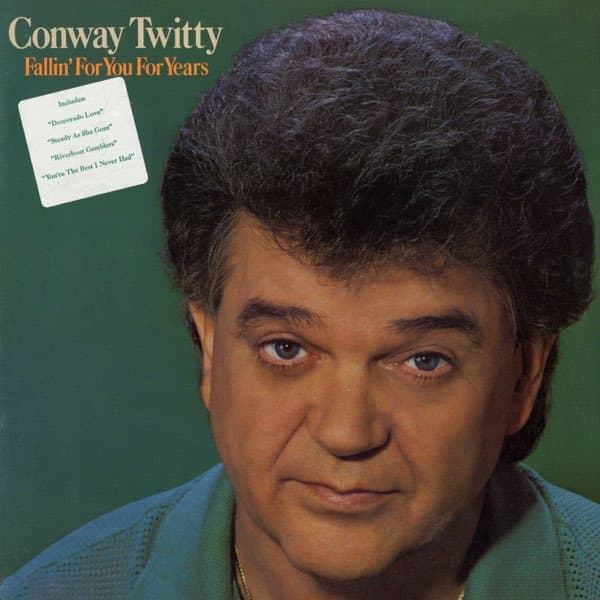
A confession whispered too late, carried on the ache of years already lost.
When Conway Twitty released “Fallin’ For You For Years” in 1986, it arrived as the title track of his album Fallin’ for You for Years, and it climbed to No. 2 on the Billboard Hot Country Singles chart. By that point, Twitty was no longer chasing validation; he had already secured his place as one of country music’s most formidable hitmakers. Instead, the song felt like a summation, a mature reflection from an artist who understood that love in country music is rarely simple and never without consequence.
The late period of Twitty’s career carried a particular gravitas. His voice, once polished and boyish in his rock and early country years, had deepened into something textured and weathered. On “Fallin’ For You For Years,” that timbre becomes the emotional architecture of the song. This is not the giddy confession of a new romance. It is the admission of a long-suppressed truth. The narrator has been quietly surrendering, year after year, to a love he either could not claim or dared not reveal.
The genius of the song lies in its restraint. The melody moves with unhurried inevitability, built on the steady pulse of traditional Nashville production of the mid 1980s. Steel guitar lines hover like distant memories, never overwhelming the vocal but framing it with a subtle melancholy. Twitty does not oversing. He leans into the lyric with a conversational intimacy, as if speaking across a kitchen table in the dim light of a rural evening.
Lyrically, the phrase “fallin’ for you for years” captures a distinctly adult sorrow. It speaks of timing gone wrong, of loyalty entangled with longing. This is love shaped by patience and perhaps by regret. In the hands of a lesser vocalist, the sentiment might verge on sentimentality. In Twitty’s, it becomes confession. His phrasing suggests a man who has counted the years in silence, who has measured each stolen glance and unspoken word.
By 1986, country music was shifting. A new generation was rising, and the polished urban cowboy era had already peaked. Yet Twitty’s voice carried authority that transcended trends. The near-top chart position was not merely a commercial achievement. It was a testament to his enduring ability to articulate the emotional interior life of his audience.
“Fallin’ For You For Years” stands today not simply as another hit in a catalog crowded with No. 1 records, but as a late-career meditation on love deferred. It is the sound of a man who understands that sometimes the most powerful romances are the ones lived quietly in the heart, waiting for courage that may arrive too late.