
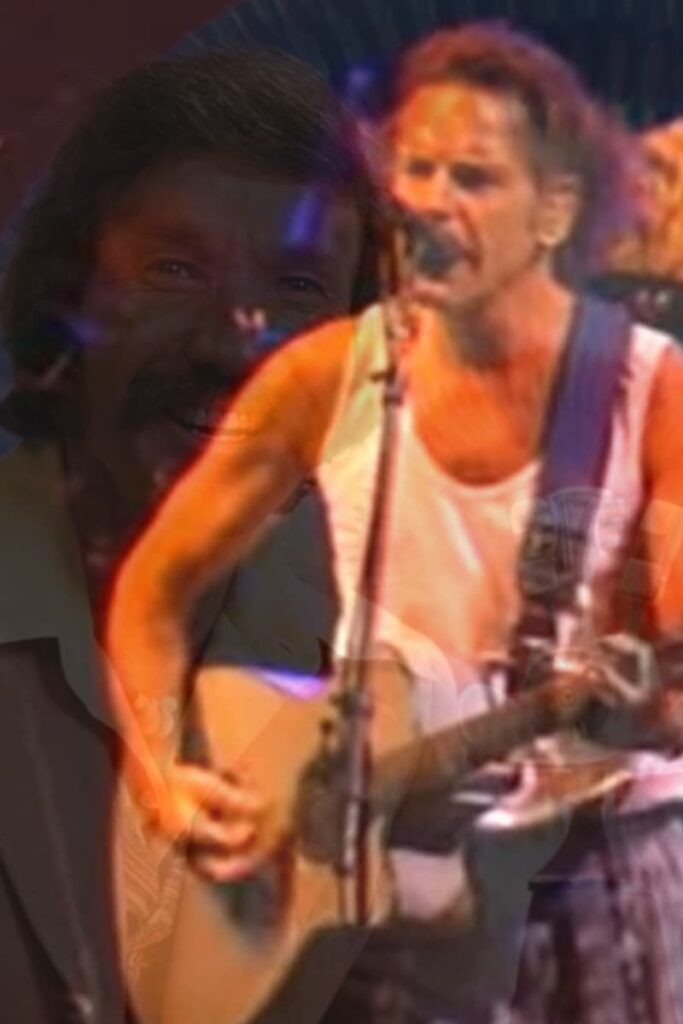
Ballad of Guilt, Flight, and Fatal Devotion That Refused to Fade
On June 26, 1994, at Soldier Field in Chicago, Grateful Dead reached deep into their mythic songbook and revived “El Paso”, the Marty Robbins classic they had been performing since the early 1970s. While this particular rendition was not tied to a contemporary chart position, the song itself had famously reached No. 1 on the Billboard Hot 100 in 1960 in Robbins’ original recording, from his landmark album Gunfighter Ballads and Trail Songs. For the Dead, however, “El Paso” was never about chart metrics. It was about storytelling, about inhabiting the American frontier myth and refracting it through their own improvisational lens.
By 1994, the band was in its final chapter. Jerry Garcia’s voice carried the weathered timbre of a man who had lived inside these songs for decades. When “El Paso” surfaced in the setlist that summer night, it felt less like nostalgia and more like ritual. The Dead had long treated Robbins’ Western tragedy not as a museum piece but as living folklore. Garcia, who adored cowboy ballads and traditional American forms, delivered the narrative with understated gravity: the jealous lover, the gunshot in Rosa’s Cantina, the doomed escape into the New Mexico badlands, and the final return to die in Felina’s arms.
The song’s structure is deceptively simple. A waltz time signature underpins a cinematic arc that unfolds with almost novelistic precision. In the Dead’s hands, that structure became elastic. They respected its melodic spine, yet their phrasing allowed the drama to breathe. The 6-26-94 performance did not radically deconstruct the tune. Instead, it honored its lineage. The guitars traced the familiar Spanish-tinged motifs, and Garcia’s vocal phrasing lingered just enough on key lines to underscore the fatalism embedded in the lyrics.
At its core, “El Paso” is a meditation on obsession and inevitability. The narrator’s love for Felina is less romance than compulsion. He kills not out of strategy but impulse, then flees not out of hope but instinct. The desert becomes both sanctuary and sentence. In performance, the Dead often emphasized this existential dimension. The song sits comfortably alongside their own meditations on fate and consequence, from outlaw ballads to cosmic laments.
There is also something profoundly American about the Dead embracing this material. They were archivists in their own right, custodians of blues, folk, country, and psychedelic experiment. By keeping “El Paso” in rotation across decades, they affirmed that the old stories still mattered. On that June evening in 1994, the ballad felt weathered yet intact, like a sepia photograph held up to the light. The frontier myth met the counterculture’s twilight, and for a few measured minutes, time collapsed into narrative: a gunshot, a horse ride, a final embrace.