
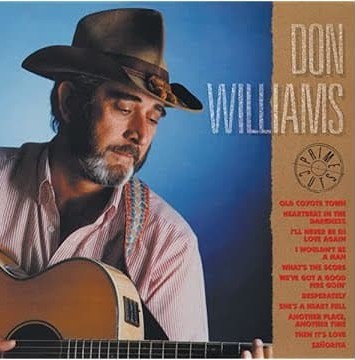
A fading frontier where memory lingers longer than the men who once gave it life
Within the later chapters of Don Williams’ recording career, Old Coyote Town emerges as a quietly evocative piece, reflective of the mature perspective that defined his enduring appeal. Associated with the album True Love, the song did not stand among his most commercially dominant releases, yet it carries the unmistakable imprint of an artist who had long since mastered the art of subtle storytelling. By this stage, Williams was no longer shaping his identity. He was refining it, distilling years of experience into songs that spoke with calm authority.
At its core, Old Coyote Town is less about a place than it is about the passage of time. The town itself becomes a symbol, a landscape marked by absence rather than presence. It is inhabited not by people, but by echoes. In the hands of Don Williams, this setting is rendered with remarkable restraint. There is no overt dramatization of decline, no sweeping declarations of loss. Instead, the song unfolds through suggestion, allowing the listener to piece together the story from fragments and impressions.
Musically, the arrangement reflects the signature minimalism that defined Williams’ work. Gentle acoustic textures, steady rhythms, and an absence of excess create a sonic environment that feels almost suspended. This stillness is not emptiness. It is space. A deliberate choice that mirrors the deserted imagery of the lyric. The music does not rush forward. It lingers, much like the memories it evokes.
Vocally, Don Williams delivers the song with the quiet confidence that had become his hallmark. His baritone, warm and unforced, carries a sense of acceptance rather than sorrow. He does not mourn the passing of the town in overt terms. Instead, he acknowledges it, allowing the weight of what is no longer there to speak for itself. This restraint is crucial. It transforms the song from a simple narrative into something more contemplative.
Lyrically, Old Coyote Town operates within a tradition deeply rooted in country and western storytelling. The idea of the abandoned town, once alive with movement and meaning, is a familiar motif. Yet here, it is approached with a gentler lens. The focus is not on the reasons for its decline, but on the quiet aftermath. What remains when the stories have already been told and the people have already moved on.
Within the broader context of Don Williams’ catalog, the song stands as a testament to his ability to find depth in simplicity. He did not rely on elaborate metaphors or complex structures to convey meaning. Instead, he trusted the power of atmosphere, of tone, and of carefully chosen words.
What lingers after Old Coyote Town fades is not a sense of finality, but of continuity. The understanding that places, like people, leave impressions that endure beyond their physical existence. And in that quiet reflection, Don Williams offers something enduring. A reminder that even in absence, there is presence, and that the stories we leave behind continue to echo long after we are gone.