
Quiet refusal that reveals how deeply the heart has already surrendered
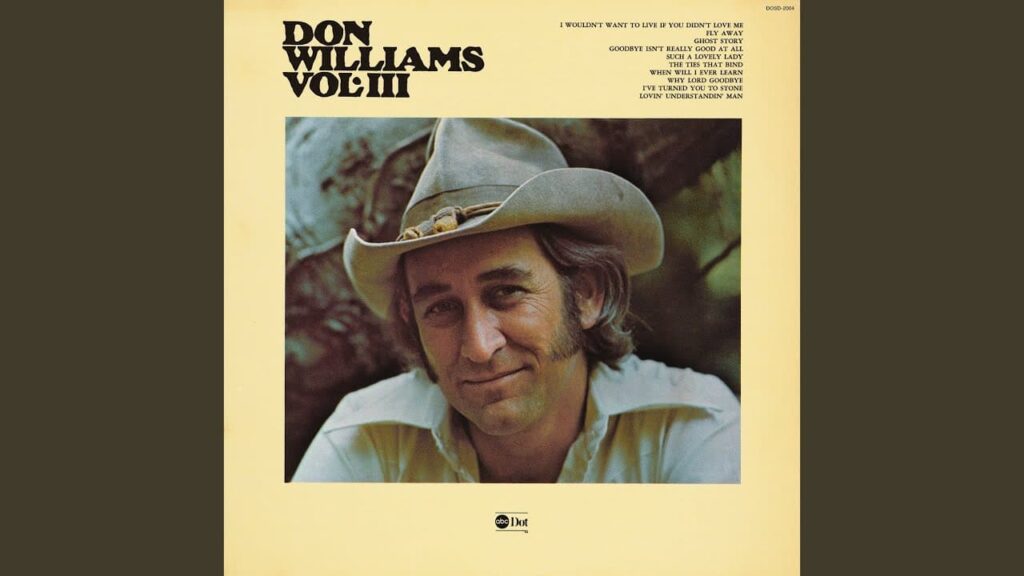
Released during a period when Don Williams was firmly established as one of country music’s most reliable chart presences, I DON’T WANT TO LOVE YOU arrived not as a headline grabbing single, but as a revealing album moment within his studio work of the mid nineteen seventies. It belongs to the era when Williams consistently placed records on the country charts through understatement rather than spectacle, allowing songs like this to deepen the emotional architecture of his albums and reinforce the calm authority of his artistic voice.
At first glance, I DON’T WANT TO LOVE YOU reads like a declaration of resistance. Yet resistance, in the world Williams inhabited so fluently, is rarely convincing. The song unfolds as an interior monologue, one shaped by restraint rather than confrontation. The speaker does not rage against love or dramatize heartbreak. Instead, he speaks in measured tones, as though hoping that careful words might undo what has already taken root. This tension between intention and inevitability is the song’s quiet engine.
Williams had an uncommon gift for inhabiting emotional paradox without explaining it away. His baritone, warm and unforced, never pleads for sympathy. It simply presents the truth as it stands. In I DON’T WANT TO LOVE YOU, that truth is the recognition that love has arrived uninvited and is unlikely to leave. The phrasing of the lyrics suggests someone who understands the cost of attachment, perhaps through experience, perhaps through observation, and yet finds himself powerless to stop the process. Love here is not romanticized. It is accepted as a condition, almost a burden carried with dignity.
Musically, the arrangement reflects this emotional posture. The instrumentation is spare and supportive, built to cradle the vocal rather than compete with it. There is no dramatic swell, no sharp turn toward melodrama. Each note seems placed with care, mirroring the singer’s effort to maintain control. This is country music at its most disciplined, where silence and space do as much work as melody.
Culturally, songs like I DON’T WANT TO LOVE YOU helped define the enduring appeal of Don Williams. At a time when country music was increasingly split between pop crossover ambition and outlaw defiance, Williams offered a third path. His songs spoke to listeners who recognized themselves in emotional understatement, in lives shaped more by endurance than rebellion. He sang for people who understood that the deepest feelings are often the least theatrical.
Over time, I DON’T WANT TO LOVE YOU has come to feel less like a refusal and more like a confession. It captures a moment of self awareness that many listeners encounter sooner or later, the realization that love does not require permission. In Williams’ hands, that realization is neither tragic nor triumphant. It is simply human. That is the quiet power of the song, and the reason it continues to resonate long after the needle lifts from the vinyl.