
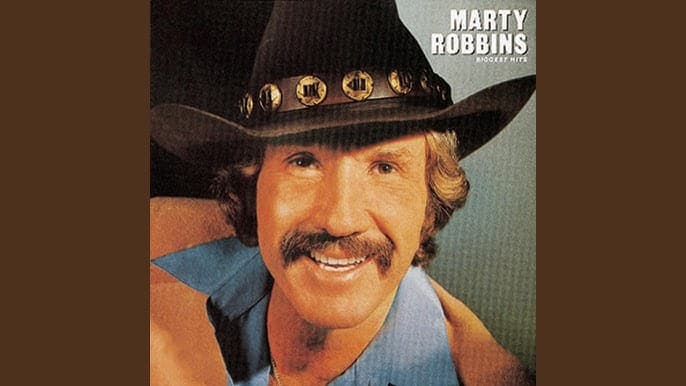
A lonely meditation on freedom and abandonment, where love is always temporary and the road always wins.
Upon its release, “She’s Just A Drifter” quietly but decisively found its audience, charting on the Billboard Hot Country Singles during a period when Marty Robbins was one of the genre’s most reliable narrators of heartbreak and wanderlust. Issued as a Columbia single in the early 1960s and later gathered into Marty Robbins albums that preserved his prolific output, the song arrived amid a remarkable run of material that balanced commercial success with a deepening emotional maturity. Robbins was, at this point, already a proven hitmaker, yet he continued to return to intimate, restrained stories like this one—songs that did not shout for attention but lingered long after the needle lifted.
At its core, “She’s Just A Drifter” is not a song of accusation. That restraint is precisely what gives it its enduring power. Robbins does not portray the woman at the center of the story as cruel or deceptive; instead, she is defined by motion. She belongs to the road, to change, to the unanchored life that resists permanence. The narrator understands this, even as he suffers from it. The tragedy here is not betrayal, but inevitability—the quiet realization that love alone cannot hold someone who was never meant to stay.
Musically, Robbins delivers the song with the measured calm that became his signature. His voice, warm yet resigned, carries a sense of hard-earned acceptance. The arrangement supports this emotional posture: unhurried, uncluttered, and rooted firmly in classic country instrumentation. There is space in the song—space for reflection, space for regret, space for the listener to inhabit the narrator’s solitude. Unlike many heartbreak songs that build toward confrontation or collapse, “She’s Just A Drifter” moves steadily forward, mirroring the very subject it describes.
Lyrically, the song taps into one of country music’s oldest and most universal themes: the tension between stability and freedom. Robbins frames drifting not as a flaw, but as a condition of the soul. The woman’s restlessness is presented almost with reverence, as though the narrator recognizes that to ask her to stay would be to ask her to stop being herself. This nuance elevates the song beyond simple sorrow. It becomes a meditation on incompatible desires—on how love can be genuine and doomed at the same time.
Within Robbins’ broader catalog, “She’s Just A Drifter” stands as a quieter companion to his more dramatic narratives. It lacks gunfights, grand gestures, or cinematic twists, yet it feels no less complete. Its legacy lies in its emotional honesty. For listeners who have loved someone untethered—someone drawn to horizons rather than hearths—the song resonates with unsettling clarity.
Decades on, Marty Robbins remains revered not only for his hits, but for songs like this: understated, compassionate, and deeply human. “She’s Just A Drifter” endures because it understands a painful truth—that sometimes the most profound losses come not from being wronged, but from loving someone exactly as they are.