
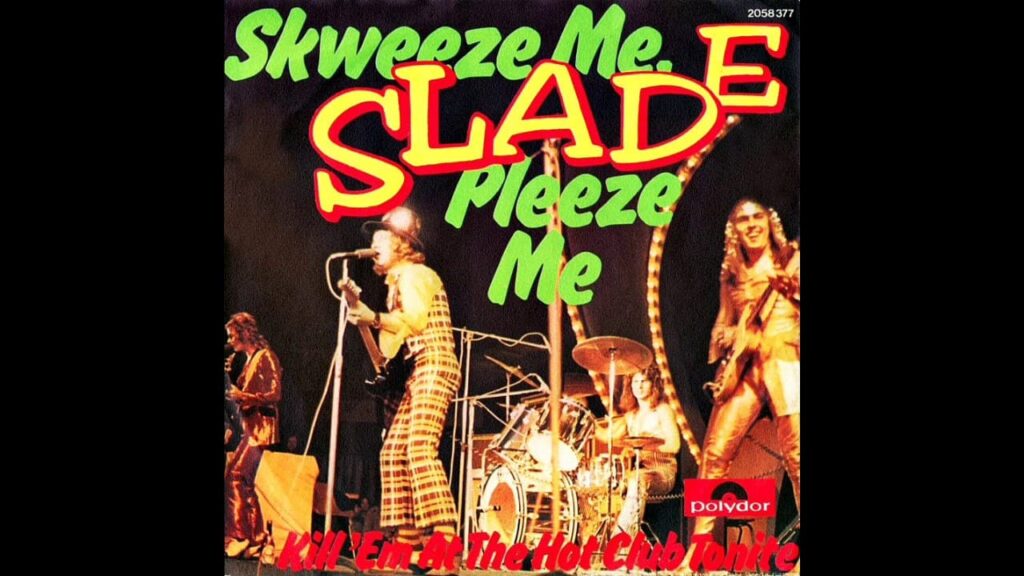
A plea that turns into a celebration of connection, noise, and the joy of being heard.
When Slade released Skweeze Me, Pleeze Me in early 1973, the song surged straight to the top of the UK Singles Chart, holding the number one position for three weeks and confirming the band’s status as one of Britain’s defining hit makers of the era. It also anchored itself within the album Sladest, a record that captured the group at full commercial momentum while preserving the raw immediacy that made their singles feel like live events pressed onto vinyl. By this point, Slade were not simply chart contenders. They were a phenomenon built on volume, personality, and an unshakable sense of communal release.
At its core, Skweeze Me, Pleeze Me is less a conventional love song than a document of appetite. It thrives on desire, but not the delicate or romantic kind. This is desire shouted across a crowded room, desire that sweats and laughs and insists on being felt. The song’s famous chorus, built on deliberate misspelling and exaggerated pronunciation, is not novelty for novelty’s sake. It is a declaration that language itself can be bent to match emotion, that spelling rules and polite phrasing collapse under the weight of urgency.
Musically, the track is engineered for maximum impact. The piano pounds rather than decorates, pushing the rhythm forward like a second drummer. The guitars do not shimmer or retreat. They stomp, creating a thick wall of sound that leaves no room for hesitation. Dave Hill’s playing is less about finesse and more about texture, while Noddy Holder’s vocal performance remains one of the great instruments of British rock. His voice is raspy, elastic, and gloriously unrestrained, turning each line into something physical. You do not simply hear him. You feel him leaning into the microphone, pulling the listener closer with every phrase.
What makes Skweeze Me, Pleeze Me endure is how openly it embraces excess without slipping into emptiness. The song understands that pleasure, whether emotional or physical, often arrives without subtlety. There is a knowing humor running beneath the bravado, a wink that suggests the band is fully aware of how outrageous it sounds and delights in that awareness. This balance between sincerity and self awareness is where Slade excelled. They invited listeners to sing along not because the message was profound, but because the experience was shared.
Within the broader context of early 1970s British pop, the song stands as a bridge between glam’s theatrical confidence and rock’s communal roar. It does not chase introspection or social commentary. Instead, it documents a moment when music functioned as a pressure valve, a place to let go. Over time, Skweeze Me, Pleeze Me has become more than a chart topping single. It is a reminder of how joy can be loud, imperfect, and unapologetic. On the turntable, it still sounds like a room full of people shouting the same feeling at once, and meaning every word.