
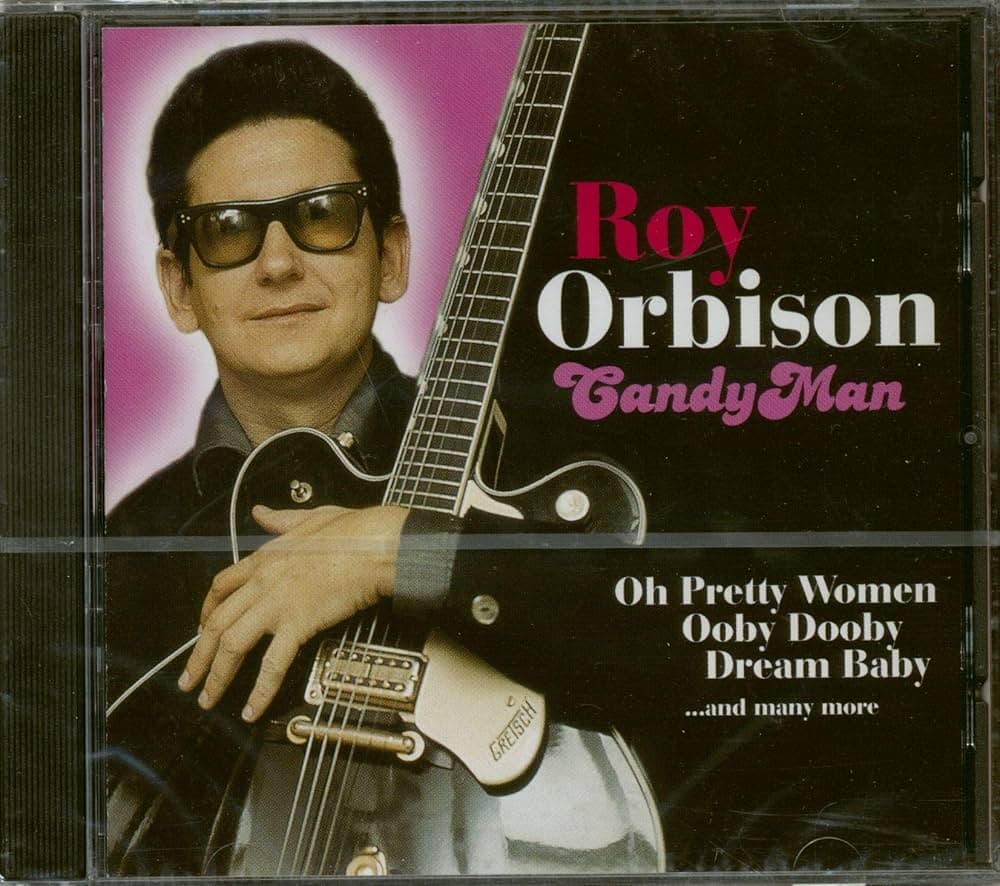
A Sweet, Soulful Seduction Wrapped in Harmonies and Harmonica
When Roy Orbison released “Candy Man” in 1961 as the B-side to his soaring hit “Crying,” he introduced a lighter, more playful side of his artistry. Despite being the secondary track, “Candy Man” charted in its own right—spending fourteen weeks on the Billboard Hot 100 and peaking at number 25. Though it wasn’t part of a studio album at first, the song later appeared on reissues of Crying and on his 1962 compilation, Roy Orbison’s Greatest Hits.
In the grand tapestry of Orbison’s catalog, “Candy Man” feels like a bright confection tucked behind a brooding ballad. The song was penned not by Orbison himself, but by Beverly Ross and Fred Neil, two very different songwriters whose collaboration yielded its irresistible charm. Ross, whose earlier credits included pop hits like “Lollipop”, teamed with Neil, who supposedly picked the metaphor of “candy man” from its harder, more ambiguous origins in New Orleans slang. Rather than lean into the bawdier connotations, they framed the candy man in affectionate, sugar-sweet imagery.
Recorded at RCA Victor Studio B in Nashville on June 27, 1961—the day after the “Crying” session wrapped—“Candy Man” features a surprisingly jaunty arrangement centered around Charlie McCoy’s harmonica, then a relative unknown. McCoy’s fluid licks spiral around Orbison’s crystalline vocals, coloring the melody with a rustic yet urbane twang.
Lyrically, the song is a playful pledge of devotion: Orbison invites his beloved to let him take her hand, to cherish her as “your candy, candy man.” There’s an innocence to the promises—“candy kisses every single night,” “sweet, sweet news for you”—that evokes mid-century romantic optimism. Unlike some of Orbison’s more dramatic, heart-torn epics, “Candy Man” doesn’t deal in longing or heartbreak. Instead, it finds warmth and comfort in simple, sweet reassurance.
Yet beneath that simplicity lies subtle complexity. The song’s pastoral charm masks its more provocative inspiration, born from a metaphor with both sensual and transactional undertones. This layered meaning—sweet on the surface, but deep in origin—speaks both to Ross and Neil’s clever songwriting and Orbison’s ability to deliver nuance in his phrasing.
Though “Candy Man” is not usually the first track that comes to mind when thinking of Orbison, its legacy endures. It was one of his earliest B-sides to chart in the U.S., proving his voice could carry more than just heartache. It also helped spotlight Charlie McCoy, whose harmonica performance contributed significantly to the song’s character and who would go on to a storied career.
In the broader contour of Roy Orbison’s career, “Candy Man” stands as a testament to his versatility—a sprightly counterpoint to his plaintive ballads, a reminder that even in his most tender moments, he could delight and charm as much as he could haunt.