
The Quiet Agony of Reunion That Won’t Let Go
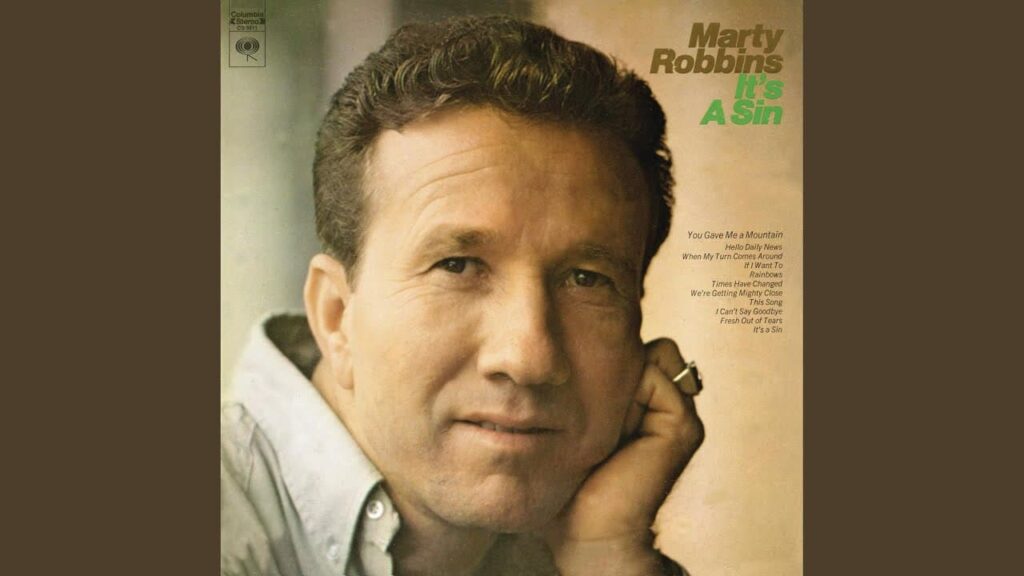
“I Can’t Say Goodbye” by Marty Robbins is a tender confession of a heart caught between the past and present—a man who returns to love, knowing he must leave again, yet finds himself unable to walk away.
Originally released on his 1969 album It’s a Sin, the track became one of the record’s standout singles, climbing to No. 8 on the country charts.
In the opening lines, Robbins captures that fragile, hesitant moment of return:
“I just stopped by to say, hello, again … just to see you … but I’m with you again and I can’t say goodbye.”
He knows someone waits beyond the door, someone he obligations to—and yet, in that stolen reunion, all sense of duty evaporates.
Though little is documented about the exact inspiration behind the song’s writing, its emotional core resonates deeply with Robbins’s broader legacy as a storyteller who could cradle sorrow in his voice. At this point in his career, Robbins was already celebrated for dramatic ballads (“El Paso,” “Big Iron”) and romantic reckonings (“My Woman, My Woman, My Wife”). On It’s a Sin, he leaned further into heartbreak that doesn’t roar—it lingers.
Unlike his more raucous or cinematic western narratives, “I Can’t Say Goodbye” is small and intimate. There’s no gunfight, no highway chase—just a man, a woman, and the weight of memory in a quiet room. The simplicity of the arrangement—warm acoustic guitar, gentle rhythm—serves to highlight Robbins’s vocal sincerity. He sings not with bravado but with the humility of someone who knows what he’s risking.
Lyrically, the song is a study in ambivalence. On one hand, the man insists he should not linger: “I shouldn’t stay long, there’s someone waiting just outside.” On the other, he struggles to sever ties: “I can’t say goodbye like I did before … I was foolish to leave it all behind.” This tension—a past left behind, a present he cannot fully embrace—is the emotional engine driving the song.
There’s also a layered regret: the world he once called his own is now only a memory, and in returning, he’s confronting not just a person, but a fragment of his former life. That regret is raw—not dramatic in a theatrical sense, but deeply human. It’s the regret of choices made, love lost, and the desperate wish for reconciliation.
Over time, “I Can’t Say Goodbye” has become a quieter jewel in Robbins’s catalog—but perhaps its very understatement is what gives it staying power. It speaks to anyone who has ever revisited a past love, hoping for a resolution, yet knowing that some wounds simply can’t be closed with a farewell. The emotional honesty is timeless.
As The Vinyl Archivist, I hear this song as Robbins at his most vulnerable—not the gunslinger or the wandering cowboy, but the man who has risked everything for love and remains too tethered by memory to ever truly leave.