
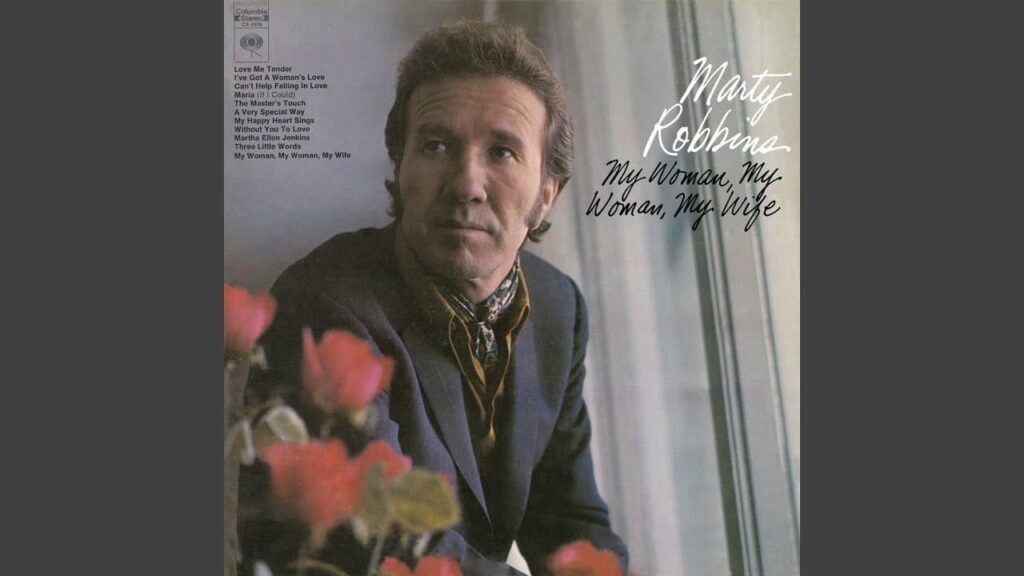
A Quiet Yearning for a Lost Embrace
When Marty Robbins touches his voice to “My Happiness,” it becomes a tender confession of longing — a romantic ache bathed in the calm of evening shadows. Though Robbins never propelled this rendition to the top of the charts, his interpretation remains a resonant pearl in his catalogue, featured on collections such as his Love Songs compilation.
From the outset, it’s crucial to understand that Robbins’s “My Happiness” is not his original composition. The song itself is a standard that dates back to 1948, written by Borney Bergantine (melody) and Betty Peterson Blasco (lyrics). Robbins, already an established country icon, adopted the piece into his repertoire, lending his warm and plaintive baritone to a melody that had already been carried by the likes of Jon and Sondra Steele, Connie Francis, and even early Elvis.
Though this version was not issued as a chart-topping single, it found a home in key retrospective albums, such as his Love Songs release — an affirmation of Robbins’s ability to wear standards as naturally as he did his original western ballads.
At its heart, “My Happiness” captures a universal ache — the yearning for a far-off beloved, the quiet agony of remembering what once was, and the hope that tomorrow might reunite the dreamer and their beloved. In Robbins’s voice, evening shadows become more than imagery; they frame a loneliness that stretches with the fading light. Lines like “When each weary day is through / How I long to be with you” embody a timeless melancholia, but Robbins doesn’t wail — he whispers, he hopes, he almost smiles in memory.
Musically, Robbins keeps the arrangement simple and elegant, staying true to the song’s pop-standard roots while subtly inflecting it with his country sensibility. The chords (largely diatonic, with gentle harmonic shifts) support his voice without overshadowing it. This restraint allows his emotional delivery to remain the centerpiece: the listener isn’t dazzled by ornate instrumentation, but drawn in by the sincerity of his longing.
Robbins’s rendition also offers a fascinating reflection on his artistic identity. Known for his Western epics — the gunfighter ballads, the cowboy lore — here he steps into the softer territory of a pop standard. In doing so, he bridges genres, demonstrating that his talent isn’t confined to the frontier or the widescreen narrative. Instead, he becomes a conduit of pure emotion, interpreting a classic love song with the same depth he might bring to tales of the Old West.
Though it may not have made waves on Billboard, Robbins’s “My Happiness” stands as a testament to his versatility and his emotional honesty. For fans of his storytelling side, it’s a precious moment: the outlaw cowboy laying down his guns and simply singing of love, longing, and the quiet ache of memory. In the broader legacy of the song — already carried by several generations — Robbins’s version adds a distinctive shade: rugged tenderness.