
A Haunting Echo of Solitude Beneath the Endless Sky
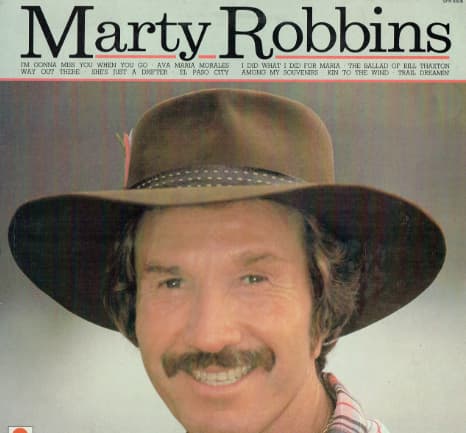
“Way Out There” is one of Marty Robbins’ most quietly haunting ballads, a song of isolation and longing carried on the wind of a remote desert night. Though not among his most commercially charted singles, it endures as a subtle gem in his catalog: recorded by Marty Robbins and featured on his 1976 studio album El Paso City.
From the first mournful yodels, the song draws you into a lonely landscape—a place “where no man may go, where the shadows have all the room.” Robbins glides into this world riding an old Southern Pacific (“that old S. P.”), humming a southern tune, until a stranger silences him and he’s cast out “way out there.”
At its heart, “Way Out There” is not a western gunfighter saga but an emotional meditation. Written by Bob Nolan, the lyrics evoke a vast, desolate geography not just of physical space but of inner loneliness. The narrator’s journey isn’t just along rails—but through memory and loss. When he meets a woman passing by and climbs in through an open door, there’s a fleeting spark—but then, turning back, he realizes he cannot stay. He rides away, and under the pale moon’s watchful eye, he admits: “sure gets lonesome way out there.”
Musically, the song’s sparse structure reinforces its emotional gravity. A slow waltzing chord progression (rooted in classic country harmony) supports Robbins’s plaintive voice and occasional yodeling, adding delicate texture without ever cluttering the space. The chord chart even shows how the melody lingers on open, sustained notes, infusing an echoing quality that mirrors the desert’s boundless horizon.
Though El Paso City was released in 1976 and reached No. 1 on the country album chart, there’s no strong record of “Way Out There” as a hit single by chart standards. This lack of commercial fanfare, however, seems almost fitting: this is a song meant not for the crowded airwaves, but for the stillness of a long ride under moonlight, where the only company is one’s own reflection.
Culturally, “Way Out There” has found a quiet afterlife beyond its original release. Western-music aficionados and modern listeners alike have embraced it as a testament to Robbins’s ability to conjure vivid emotional terrain with just a few simple lines. As one podcast on western songs reflects, it’s exactly this kind of evocative storytelling—“about the outdoors,” “about loneliness”—that helped define the genre for later generations.
In the cadence of Marty Robbins’s voice, you feel both the freedom of the open road and the weight of an aching heart. “Way Out There” is a song of beautiful emptiness: a horizon stretched thin, a moment paused beneath indifferent stars, and a soul quietly calling out into the darkness.