
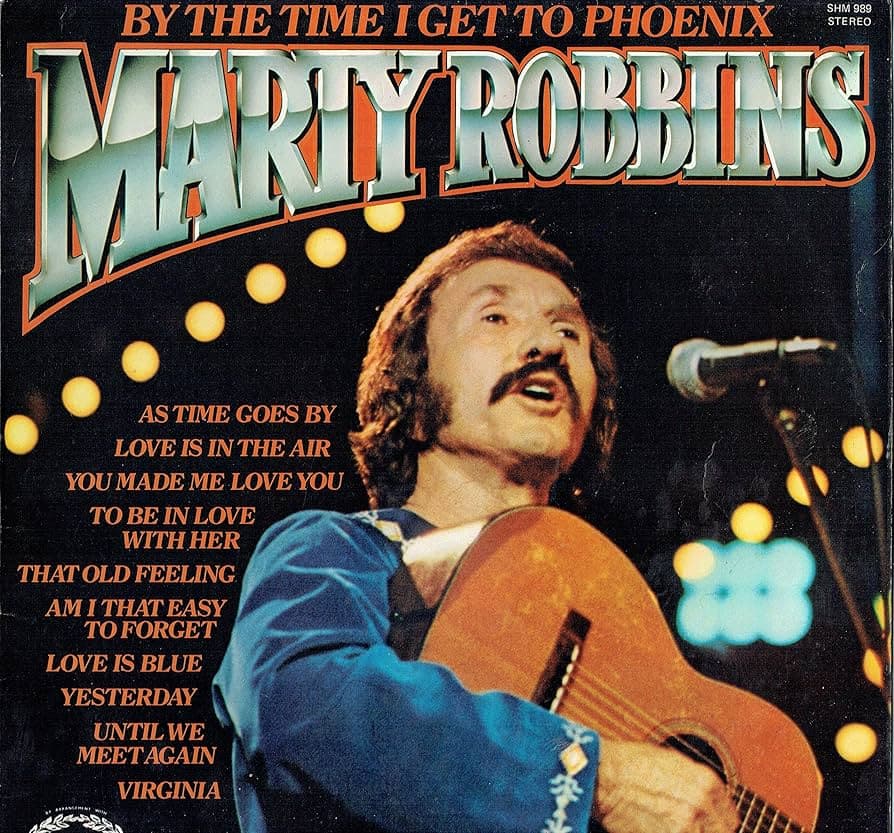
A Wistful Farewell That Fades into the Distance
When Marty Robbins sings “By the Time I Get to Phoenix”, he carries the ache of departure in a voice softened by regret and longing — a quiet confession of leaving not just a place, but a love, behind.
Robbins recorded the song on his By the Time I Get to Phoenix album, released in May 1968 by CBS Records. That album climbed to #8 on the U.S. country charts, proving that Robbins’ contemplative turn resonated deeply with his audience.
The Story Behind the Song
Though Robbins made his version of “By the Time I Get to Phoenix” his own, the song was originally written by Jimmy Webb — the same lyrical craftsman behind “Wichita Lineman” and “MacArthur Park.” In numerous interviews, Webb has clarified that the song is less of a literal road trip than a bittersweet fantasy — he never actually drove off to Phoenix. Rather, it’s a narration of desire and regret, the kind that lives in memory and what-ifs.
Webb once recalled how someone after a concert tried to map out his journey — timing how long it would take to drive from L.A. to Phoenix and then on to Albuquerque — and concluded: “This song is impossible.” But Webb embraced that impossibility. He said the song takes place in a “twilight zone of reality” — a poetic space where emotional distance becomes geographical, where leaving is felt in heartbeat even if the miles are never traveled.
There’s a subtle twist here, reminiscent of an O. Henry story: the narrator’s goodbye is real, even if his journey never physically happened. Webb once described it by saying, “She didn’t really think that I would go, but I did — and yet I stayed.”
Lyrical and Emotional Architecture
Robbins’ rendition draws on this emotional architecture with a delicate restraint. The song unfolds in three acts — Phoenix, Albuquerque, Oklahoma — each city not just location, but emotional marker. As the narrator imagines what his lover might do when she reads the parting letter, he watches her through his mind’s eye: perhaps she calls, perhaps she cries, but by the time he reaches each destination, she has lost track of him.
In his voice, Robbins brings a calm sadness: not anger, but a tender acknowledgment of what is. The journey becomes internal: each place he names is less a physical stop than a measure of how far he has drifted in her memory. There’s regret, yes — but there is acceptance.
Musically, Robbins’ version is understated. Stripped of flash, the arrangement supports the emotional core without overwhelming it. This simplicity allows the lyrics to breathe, giving clarity to every syllable, every pause.
Legacy and Cultural Resonance
Robbins’ choice to record this song — one most strongly associated with Glen Campbell, whose 1967 version famously reached #2 on the country chart — offers a testament to his interpretative depth. While Campbell’s version leaned into sweeping orchestration and pop sophistication, Robbins embraces the song’s minimalist intimacy, making it feel like a letter spoken aloud.
Over time, “By the Time I Get to Phoenix” has become a standard not just in country music but across genres. It’s covered by singers and instrumentalists, reimagined in soul and pop, and taught as an example of songwriting that traverses space and emotion with equal care.
In Robbins’ hands, the song becomes a meditation on distance — not just physical but emotional — and on the quiet courage it takes to walk away, even when the heart is still very much there.