
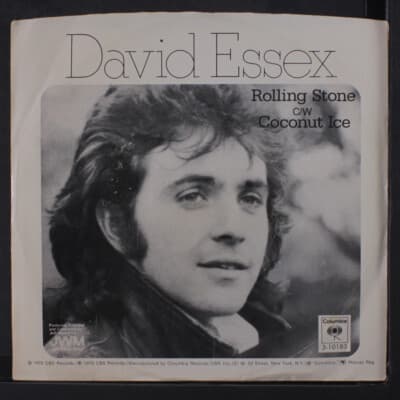
A restless heart drifting free forever
In 1975, David Essex released Rolling Stone as a single from his third studio album All the Fun of the Fair. The song climbed to No. 5 on the UK Singles Chart where it remained for several weeks, marking a notable moment in Essex’s mid-70s run of hits.
The very first note of “Rolling Stone” carries with it a sense of restless motion — a pulse that refuses to settle. As the track unfolds, bass and keyboard swirl with a smoky urgency that complements the weariness etched in Essex’s voice. Behind that sound lies the creative hand of longtime collaborator Jeff Wayne, whose production helped anchor the song’s mood somewhere between a wandering soul’s lament and a confession whispered across a dim, empty bar.
“Rolling Stone” arrives at a particular moment in Essex’s journey — at the apex of a creative stretch that followed his earlier breakthrough with songs such as “Rock On” and “Gonna Make You a Star.” By mid-1975, his third album offered a canvas broad enough to hold both glam-tinged pop and darker, more introspective pieces. That contrast between bright stardom and shadowed solitude is what makes “Rolling Stone” stand out. On one hand, it capitalizes on Essex’s teen idol persona; on the other, it channels a far older, deeper ache.
Lyrically, the song adopts the metaphor of the drifter — a soul condemned to roam, carrying no load, anchored to no hearth, destined only for motion. Essex’s narrator is unwilling or unable to tether himself to stability. Instead, there is in his tone an acknowledgement of freedom’s isolation. The chorus — asserting identity as a “rolling stone” — feels less celebratory and more resigned. The soundscape underlines that resignation: shadowy keys, haunting backing vocals, a bassline that rambles more than it grooves. The emotional pulse suggests longing not just for place or person, but perhaps for rest.
In the broader arc of Essex’s career, “Rolling Stone” embodies duality. It reflects the era’s sensibilities — glam rock’s faded glitter, the growing introspection of singer-songwriters — while maintaining pop accessibility. It appealed to fans drawn to Essex’s public charisma, even as it offered a touch of gravity and depth. That tension helped cement the track as one of the memorable highlights of the All the Fun of the Fair album, and a defining moment in his mid-70s output.
Listening to “Rolling Stone” today, one hears more than a mid-70s single that charted well. It resonates as a meditation on movement and solitude, on the cost of freedom and the weight of rootlessness. In that space between longing and release, David Essex offers not just a song, but a confession — carried in the shadowed crackle of studio echo and sealed with the certainty that some hearts are meant to keep rolling even when they ache for home.