
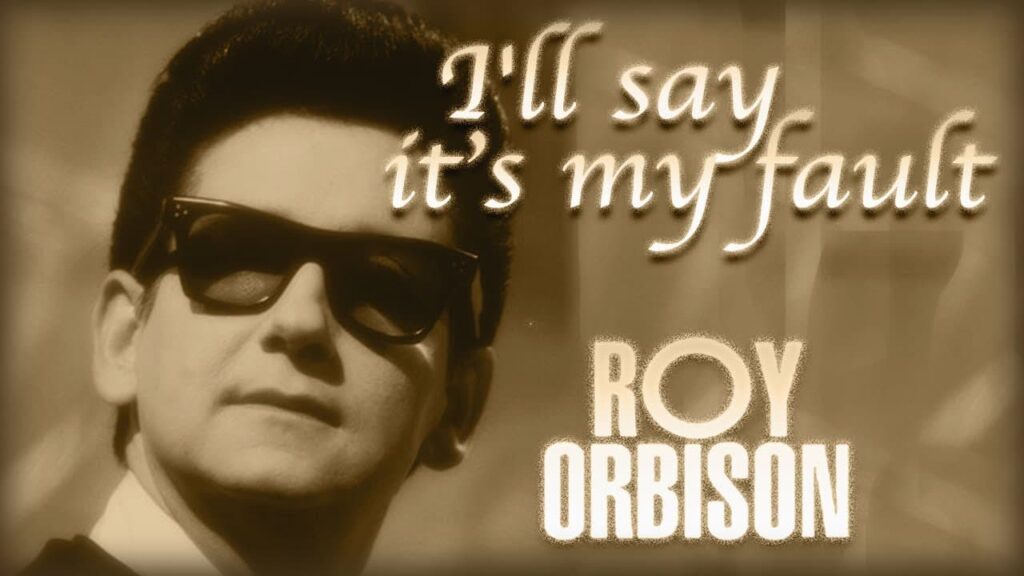
“I’ll Say It’s My Fault” embodies the wounded dignity of love’s last stand.
In the deep tapestry of Roy Orbison’s early catalog, “I’ll Say It’s My Fault” stands as a compact, aching confession tucked into the closing sequence of Sings Lonely and Blue—the 1961 album that began to define Orbison’s singular voice in the dawn of the 1960s. While this particular track was not issued as a chart single in its own right and thus lacks a definitive Billboard Hot 100 placement, it occupies a musical space alongside immortal hits like “Only the Lonely” and “Cry,” both of which did drive chart success and critical attention for Orbison around this period.
Recorded in Nashville under the meticulous guidance of producer Fred Foster and released on Monument Records, Sings Lonely and Blue is widely regarded as a watershed moment in Orbison’s artistic evolution. The album’s charts and reviews from the time reflect a collection that, beyond its singles, offered depth and emotional nuance rare in its era: Billboard named the LP a Spotlight Winner of the Week, and critics of the period noted its striking blend of country, pop, and rock—an early countrypolitan strain anchored by Orbison’s operatic tenor.
The opening bars of “I’ll Say It’s My Fault” strike with deceptive simplicity—short, rhythmic, and poised just outside the grander sweep of Orbison’s ballads. But within its brisk 2:21 runtime lies a textural tension that embodies the terse honesty of heartbreak. The narrator accepts sole blame for a relationship’s collapse, offering theatrical contrition to deflect gossip and quell outside speculation. Even as he self-assigns the fallibility—“I’ll take all the blame,” he sings—there lingers a subtext of wounded pride: the very act of declaration becomes performance, as though the speaker must convince himself as much as his circle.
Unlike his more operatic laments, here Orbison’s voice threads subtly between resignation and bravado. Surrounded by tight, classic Nashville session work—sax accents, gentle guitar fills, and restrained rhythm—the singer’s phrasing mimics the ambivalence of someone both over and under the moment: over the relationship, yet under the weight of lingering affection. The music mirrors this tension, its major key and moderate tempo offering a bittersweet backdrop to lyrics that confess and conceal in equal measure.
Lyrically, the song unfolds almost like a short story of emotional survival. The narrator’s promise to take the blame is less about genuine culpability than about controlling the narrative in a post-mortem of love. To say it’s his fault is safer than unveiling the true messiness beneath—an admission that, in Orbison’s hands, resonates with a poignant mix of vulnerability and self-preservation.
Though not a commercial blockbuster, “I’ll Say It’s My Fault” encapsulates a rare Orbison trait: the ability to make listeners feel as though they are eavesdropping on an unguarded interior monologue. In the grand gallery of his work, this song lingers like a glance back at a closed door—brief, haunting, and rich with unspoken sentiment.