
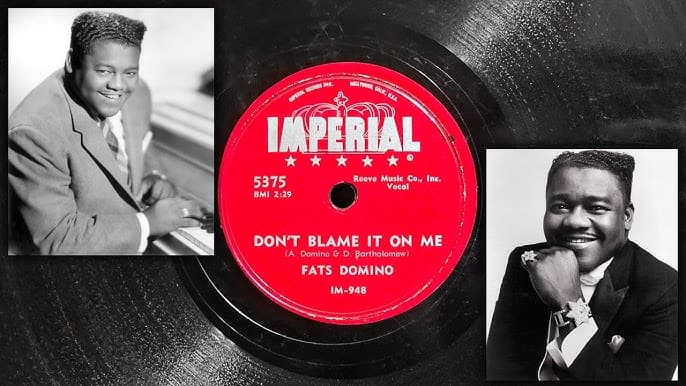
“Don’t Blame It on Me” is the plaintive confession of unwavering devotion wrapped in the unshakable rhythmic pulse of New Orleans rhythm and blues.
Upon its original release in 1956 as the B-side to “Bo Weevil,” Fats Domino’s “Don’t Blame It on Me” resonated on the R&B charts, reaching number nine, and appeared on his seminal 1956 album Rock and Rollin’ with Fats Domino at a moment when Domino’s work was shaping the sound of early rock and roll and crossing deep into the American musical psyche.
From the first bar of Domino’s warm, rolling piano, this song carries the weight of a heartfelt plea—simple in its surface language yet rich with emotional texture. Co-written with his long-time collaborator Dave Bartholomew, the tune eschews ornate flourishes in favor of an earnest narrative: the speaker insists he is blameless in a faltering love affair, not out of evasiveness, but out of a profound conviction in his own constancy.
At the heart of the track is Domino’s elegant melding of rhythm and feeling. His piano triplets, a signature element of his style, create a gentle forward momentum that mirrors the cyclical nature of reflection and plea in the lyrics. In Domino’s hands, the rhythms are never merely backing; they are emotional currents that carry the words beyond their literal meaning and into a space where listener and performer share in the vulnerability and resolve of the song’s central voice.
Lyrically, “Don’t Blame It on Me” is a meditation on accountability and emotional transparency. Lines like “I’m not guilty, can’t you see? / I’m the same as I used to be” evoke a speaker caught between steadfast affection and the frustration of being misunderstood. The refrain is less a defensive claim than a revelation of commitment: despite perceived shortcomings or the passage of time, the core of his love remains unchanged. Within the context of mid-1950s America, when domino’s music was threading the sensibilities of rhythm and blues into the broader tapestry of popular culture, this thematic simplicity was also a strength—it was universal, direct, and deeply human.
Moreover, the song exemplifies how Domino’s music could simultaneously adhere to traditional R&B forms and presage the emotional directness that would become central to rock and roll balladry. His vocal delivery—unembellished, sincere, and imbued with a gentle buoyancy—suggests a storyteller who has lived the narrative rather than merely reciting it. This quality is why many of his tunes, “Don’t Blame It on Me” included, retain their power decades later: they were, at their best, confessions set to unforgettable grooves.
In listening today, one hears not just a chart entry from 1956, but an intimate exchange between performer and audience. It is music that invites reflection on the nature of love, blame, and responsibility, rendered through the unmistakable voice and keys of Fats Domino at a pinnacle of creative influence.