
A Quiet Reckoning With Love Remembered After the Fire Has Gone Cold
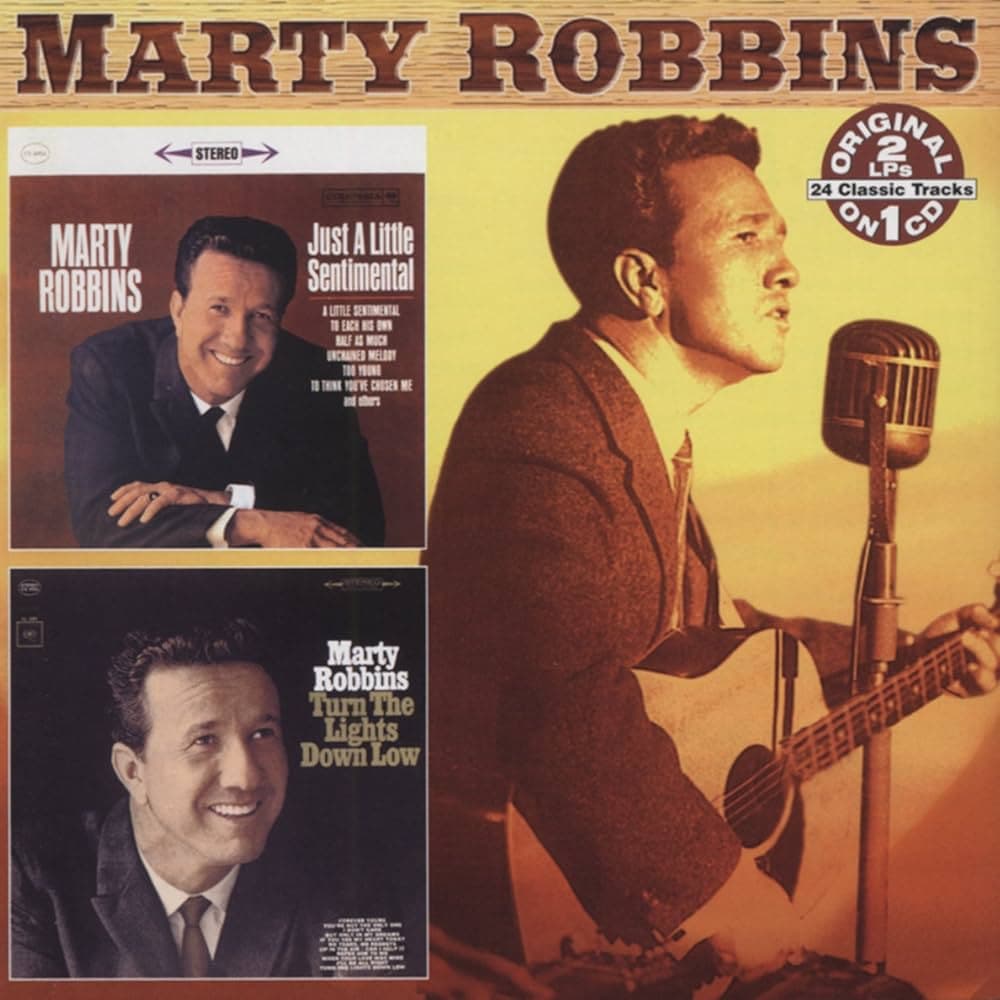
Marty Robbins released A Little Sentimental during a reflective phase of his career, as the title track of the album A Little Sentimental, issued by Columbia Records in the early 1970s. The song was not positioned as a chart driving single, nor did it arrive with the commercial urgency of his earlier crossover hits, but it belonged to an album that spoke directly to his long standing country audience, one attuned to emotional nuance rather than radio spectacle. By this point, Robbins was already an established institution, a voice whose authority came not from novelty but from endurance, and A Little Sentimental arrived as a quiet reaffirmation of that bond.
The song unfolds as a meditation rather than a confession. Where many of Robbins’ most famous recordings dramatize heartbreak or moral reckoning through vivid narrative, A Little Sentimental turns inward. It is not concerned with what love did wrong, but with what remains after time has softened the sharper edges of loss. The lyric does not plead, accuse, or dramatize. Instead, it acknowledges the persistence of feeling, the way memory lingers long after resolution is supposed to have occurred. Sentimentality here is not weakness. It is residue.
Musically, the arrangement is deliberately restrained. The tempo moves at an unhurried pace, allowing Robbins’ baritone to breathe between lines. The instrumentation supports rather than decorates, creating a space where the voice carries the emotional weight. This was one of Robbins’ greatest strengths, his ability to sound reflective without becoming fragile, emotionally open without surrendering dignity. In A Little Sentimental, that balance is central to the song’s power.
Lyrically, the song addresses a truth often ignored in popular music, that closure is rarely complete. Even after love has passed, even after distance has been established, something remains. Robbins sings not as a man undone by longing, but as one mature enough to accept that memory has its own quiet life. This perspective resonated deeply with adult listeners who had lived through love rather than merely imagined it. The song does not ask the listener to relive youth. It asks them to honor experience.
Within Robbins’ broader catalog, A Little Sentimental stands as an example of his late period emotional clarity. By the early 1970s, he no longer needed sweeping story songs to prove his artistry. Instead, he leaned into understatement, trusting that a simple emotional truth, delivered honestly, would find its audience. The album A Little Sentimental reflects this philosophy throughout, favoring warmth, patience, and emotional maturity over dramatic flourish.
Today, the song endures not because it dominated charts, but because it captures something timeless. It speaks to the listener who understands that sentimentality is not indulgence, but recognition. Recognition of what once mattered, of what shaped the heart, and of what never entirely leaves. In A Little Sentimental, Marty Robbins reminds us that the past does not demand to be reopened to remain meaningful. Sometimes, it only asks to be remembered quietly, with respect.