
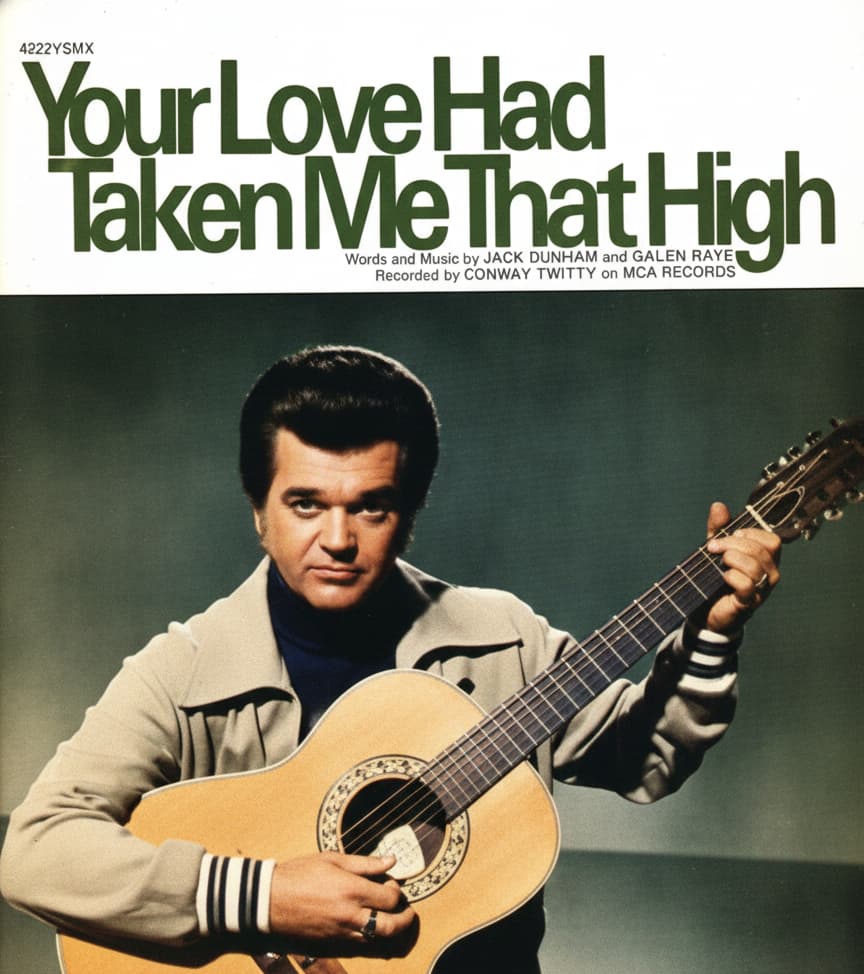
A love so elevating it feels earned rather than declared
Upon its release during the commercial zenith of Conway Twitty, Your Love Had Taken Me That High rose to the very top tier of the Billboard Hot Country Singles chart, affirming Twitty’s singular ability to translate emotional intimacy into mass resonance. Issued as a standalone single and later housed within one of his mid 1970s studio albums, the song arrived at a moment when Twitty’s voice had fully settled into its mature authority, a voice that no longer chased sentiment but allowed it to arrive on its own terms.
What distinguishes Your Love Had Taken Me That High from many of its contemporaries is its refusal to dramatize love as conquest or spectacle. Instead, the song frames love as elevation, a gradual ascent shaped by trust, surrender, and emotional risk. The title itself is revealing. This is not a narrator boasting of romantic triumph. It is a man recognizing that something external, someone else’s devotion, has lifted him beyond his own emotional limits. In Twitty’s hands, that realization becomes quietly profound.
Lyrically, the song operates within the familiar architecture of classic country songwriting, yet it subverts expectation through restraint. The language is plain, even conversational, but every phrase carries weight because it is delivered without excess. Twitty sings not as a man discovering love for the first time, but as someone who has known disappointment and recognizes the rarity of what he now holds. The emotional power lies in that contrast. Love feels higher precisely because the ground beneath him was once so low.
Musically, the arrangement mirrors the lyric’s upward motion. The production favors a steady, unhurried tempo, allowing Twitty’s phrasing to breathe. Subtle instrumentation supports rather than competes, creating a sense of space that emphasizes reflection over urgency. This was a hallmark of Twitty’s mid career recordings, where confidence replaced bravado and emotional clarity became the defining feature. The song does not rush to its chorus. It arrives there naturally, as if ascent cannot be forced.
Within the broader arc of Conway Twitty’s legacy, Your Love Had Taken Me That High stands as an exemplar of why he dominated country radio for so long. He understood that adult audiences did not need exaggeration. They needed recognition. This song speaks to listeners who have lived enough life to know that love’s greatest moments are often quiet and inward. Its success on the charts was not merely a function of popularity, but of identification. People heard themselves in it.
Decades later, the song endures because it captures a universal emotional truth. Love, when genuine, does not announce itself loudly. It changes the altitude of the soul. Twitty’s performance preserves that truth with grace, offering not a declaration, but a testament.