
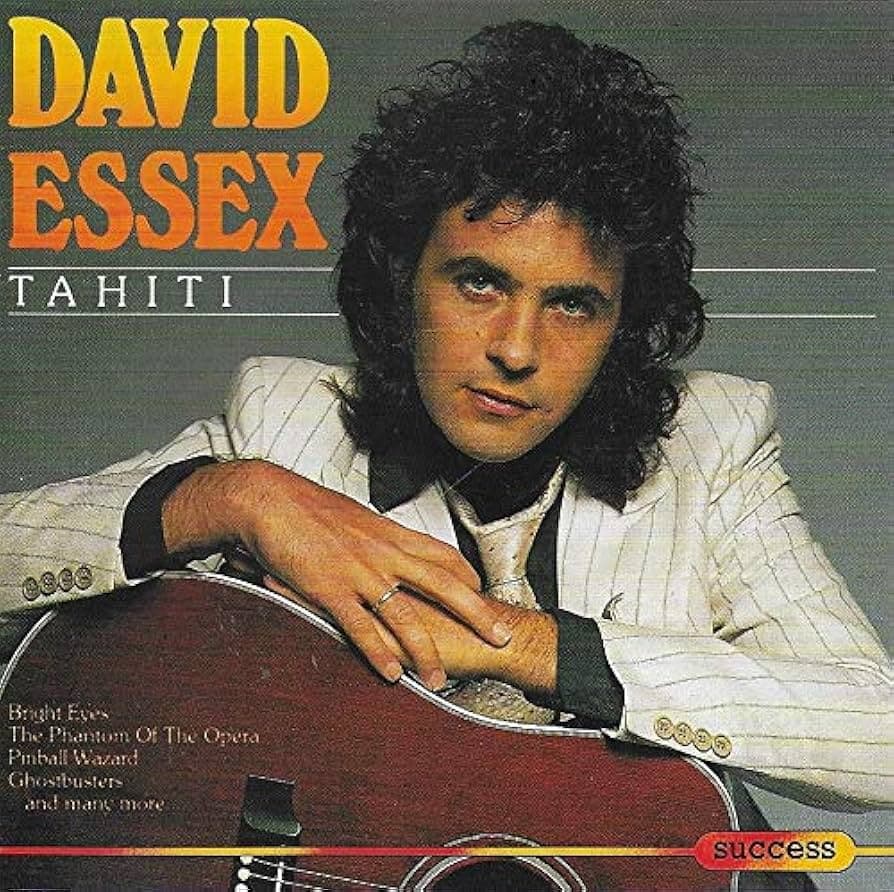
A yearning for freedom and paradise sung from the deck of a storm-tossed ship
“Tahiti” arrived in the summer of 1983 as a luminous, melodic beacon in David Essex’s long and varied career, climbing to number eight on the UK Singles Chart and sustaining its presence for twelve weeks. It emerged from the concept album for Mutiny!, the ambitious musical that Essex co-wrote and later starred in on the West End stage, and stands among his last major Top 10 hits of that period.
At its surface “Tahiti” may be catalogued as a show tune, tied to the narrative of a theatrical retelling of Mutiny on the Bounty, but its expressive canvas extends far beyond staged drama. Essex’s musical journey to this song came after a decade of chart dominance in the 1970s, where he ranged from glam-inflected rock to introspective pop balladry. By 1983 he had already etched classics such as “Rock On” and “A Winter’s Tale” into the British musical consciousness. “Tahiti” arrived not as a diversion but as a synthesis of his storytelling instincts and an earnest fascination with narrative mythos.
Embedded in the broader framework of Mutiny! — itself a dramatic reimagining of one of literature’s most enduring seafaring sagas — “Tahiti” serves as both a lament and a promise. The song’s lyrics evoke an almost utopian vision of the eponymous island, not just as a physical place but as the locus of freedom, renewal, and transcendence. In this portrayal Tahiti becomes an emotional anchor: the distant shore toward which both the protagonists’ battered bodies and fragile hopes relentlessly drift. The melody is buoyant, tinged with Pacific-light resonance, yet Essex’s vocal delivery anchors it with a reflective gravity. The duality of aspiration and longing in his phrasing suggests that paradise is as much an inner state as an external destination.
Musically the piece stands apart in Essex’s canon for its gently swelling arrangement that blends pop sensibilities with the more expansive ambitions of musical theatre. The harmonic progression, supported by broad instrumentation, allows the emotional thrust to build steadily: each chorus feels less like repetition and more like reaffirmation of the yearning that propels the characters forward. In a career defined by hits that captured both youthful desire and wistful retrospection, “Tahiti” is notable for how it frames longing as a communal experience. The listener is led to feel not only what the characters in Mutiny! are chasing, but also what Essex himself seems to be seeking in his artistic evolution — an ideal that reconciles the roughness of life with the beauty we imagine at the horizon.
Upon its release and subsequent chart performance, “Tahiti” affirmed Essex’s capacity to transcend the boundaries of pop single and stage number alike. It did so without forsaking accessibility, inviting listeners unfamiliar with Mutiny! to embrace its emotional core. In the decades since, the song has retained a distinct place in the narrative of Essex’s oeuvre, offering a poignant meditation on the human impulse to pursue hope even after storm and strife.