
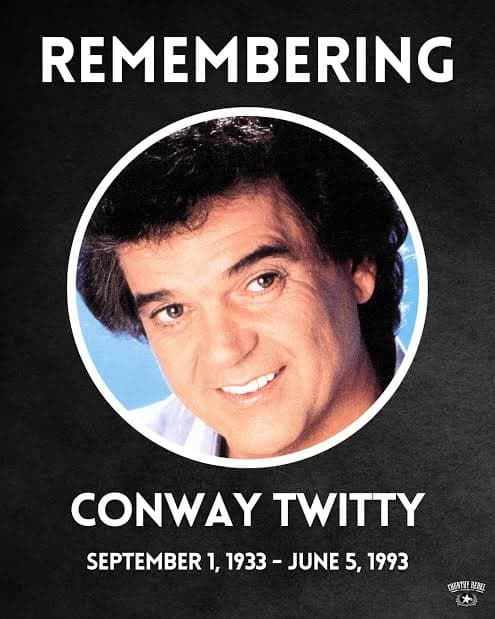
A Voice That Carried the Heartache of a Nation Fell Silent in 1993
When Conway Twitty passed away on June 5, 1993, country music did not merely lose a singer; it lost one of its most commercially dominant and emotionally resonant voices. Born Harold Lloyd Jenkins in 1933, Twitty built a career that defied easy categorization, first conquering the pop charts with “It’s Only Make Believe,” a No. 1 hit on the Billboard Hot 100 in 1958, before reshaping himself into one of country music’s most formidable forces. By the time of his death at age 59, he had amassed 40 No. 1 country singles on the Billboard Hot Country Songs chart, a record that stood for years as a benchmark of consistency and command.
His passing followed a sudden abdominal aortic aneurysm after a performance in Branson, Missouri. That detail, stark and clinical, stands in haunting contrast to the warmth of the voice that had just hours earlier filled a theater. It was as if the stage itself had been the final witness to a lifetime of devotion.
To understand the magnitude of Twitty’s absence, one must consider the arc of his transformation. In the late 1960s and through the 1970s, albums such as “Hello Darlin’” and later “Linda on My Mind” did more than produce chart-toppers; they crystallized a persona. Twitty was not merely singing about heartbreak. He was embodying it. His baritone possessed a grain that suggested experience rather than performance, a tone weathered but never cynical. The famous spoken introduction to “Hello Darlin’” remains one of the most instantly recognizable openings in country music, its unhurried phrasing creating an intimacy that felt almost intrusive, as though listeners were overhearing a private confession.
Thematically, Twitty’s catalog traced the fragile architecture of adult relationships. Infidelity, regret, longing, and reconciliation were not abstract concepts in his songs. They were lived-in rooms. In duets with Loretta Lynn, including standards like “Louisiana Woman, Mississippi Man,” he explored romantic tension with a theatrical realism that electrified audiences while remaining rooted in rural authenticity. These collaborations yielded multiple No. 1 hits and expanded his reach beyond the solitary lament into conversational drama.
Twitty’s vocal control was meticulous. He favored measured phrasing over vocal acrobatics, allowing silence and restraint to heighten emotional impact. In an era when country music wrestled with its identity amid crossover pressures, he stood as a figure of continuity. His success was not accidental; it was architectural. Each release reinforced the image of a man who understood the cost of love.
His death in 1993 marked more than the end of a career. It closed a chapter in which commercial dominance and emotional sincerity coexisted without irony. Twitty’s legacy is quantifiable in chart statistics, yet its true measure resides in the countless listeners who found their own unspoken confessions echoed in his songs. When that voice fell silent, a particular timbre of country music—earthbound, intimate, unguarded—receded with it, leaving behind a catalog that still breathes with human vulnerability.