
The ache of memory that never quite lets the heart forget its first true warmth
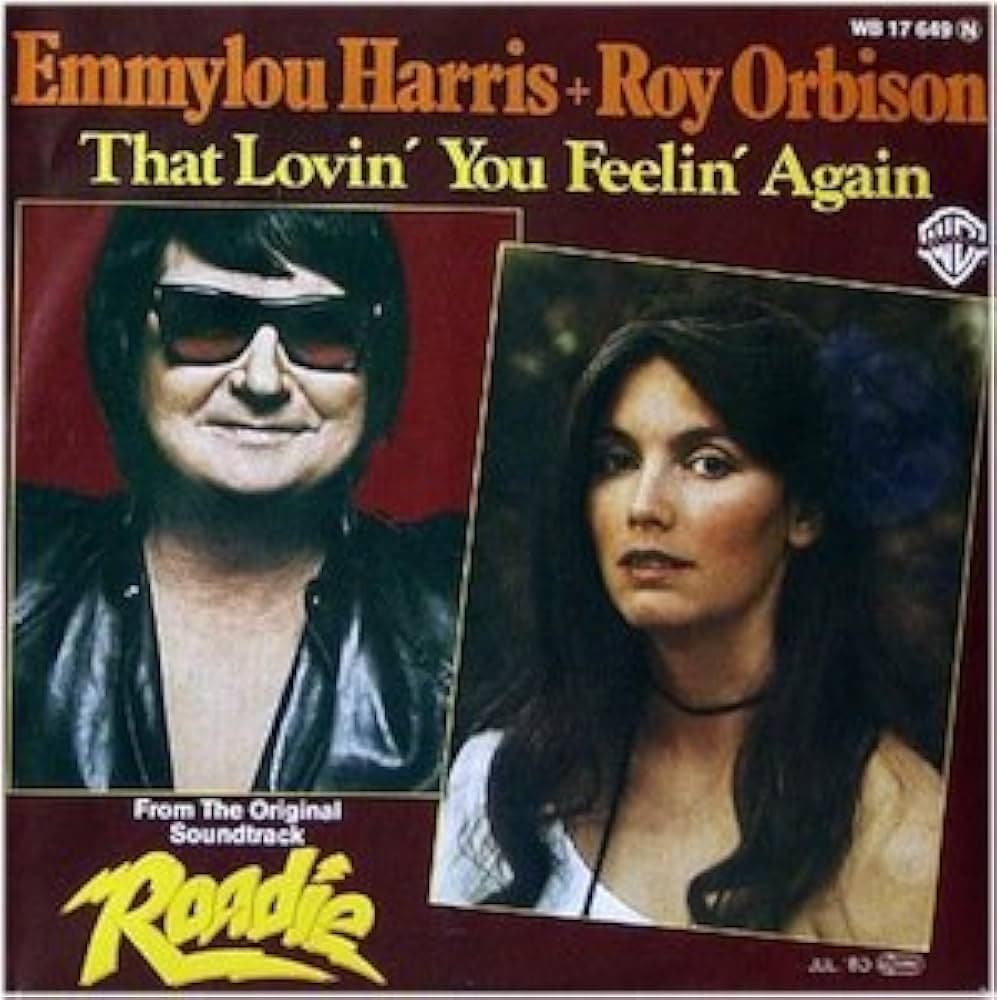
In the summer of 1980 “That Lovin’ You Feelin’ Again” emerged as an understated yet poignant entry in both Roy Orbison’s late-career canon and Emmylou Harris’s evolving body of work. Issued as part of the soundtrack to the film Roadie, the duet carried these two voices into the charts with a quiet persistence that belied its emotional depth, spending eight weeks on the Billboard singles chart and peaking at #55 in the United States. It was one of Harris’s rare crosses onto the Hot 100 and marked a high point in her early 1980s success on the country and adult contemporary charts.
From the first alternation of lines, the song unfolds as a meditation on love’s lingering shadow. Orbison and Harris, coming from distinct but complementary lineages of American music, merge seamlessly here: his voice with its tremulous, storied tenor, hers with a clarity that carries every lyric like a confession. The music, built around a gently swaying tempo and instruments that nod to country’s steel-string heart, creates a space where memory and desire intertwine. There is no grand drama in the arrangement; the drama lives in the emotional architecture of the song itself—how its refrain circles back on itself like thought repeating in the quiet of night.
Lyrically, “That Lovin’ You Feelin’ Again” resists the neat closure of a conventional love song. The narrator encounters a figure from the past “standing there on the street” and instantly feels drawn back into something once cherished. This is not the sudden ignition of new romance but the slow, inevitable pull of what is already known. The phrase “lovin’ you feelin’ again” operates both as a simple statement of sensation and as a deeper metaphor for the way old emotions can persist stubbornly, despite time and circumstance.
In the interplay between Orbison and Harris, there is an implied dialogue of experience and perspective. Orbison, whose career had spanned decades and seen both triumph and personal tragedy, brings to his lines a weight that only time can lend. Harris, by 1980 already celebrated for her ability to marry traditional country sensibilities with folk inflection, answers with a voice that is both anchored and aspirational. Together they render the song’s narrative less a story of reunion than an exploration of longing itself—of past closeness that was “so close” yet “too far apart,” as the lyric quietly laments.
The song’s cultural legacy resides not in blockbuster chart success but in its affirmation of love’s complexity. In avoiding the pomp of arena productions or the slickness of pop crossover ambitions, “That Lovin’ You Feelin’ Again” captures that strange human truth: that the echoes of earlier affections never fully fade, that memory can be both solace and torment. Orbison and Harris each bring to this duet a lifetime of feeling, and what remains at the end is not resolution but the lingering warmth of a connection that refuses to disappear.