
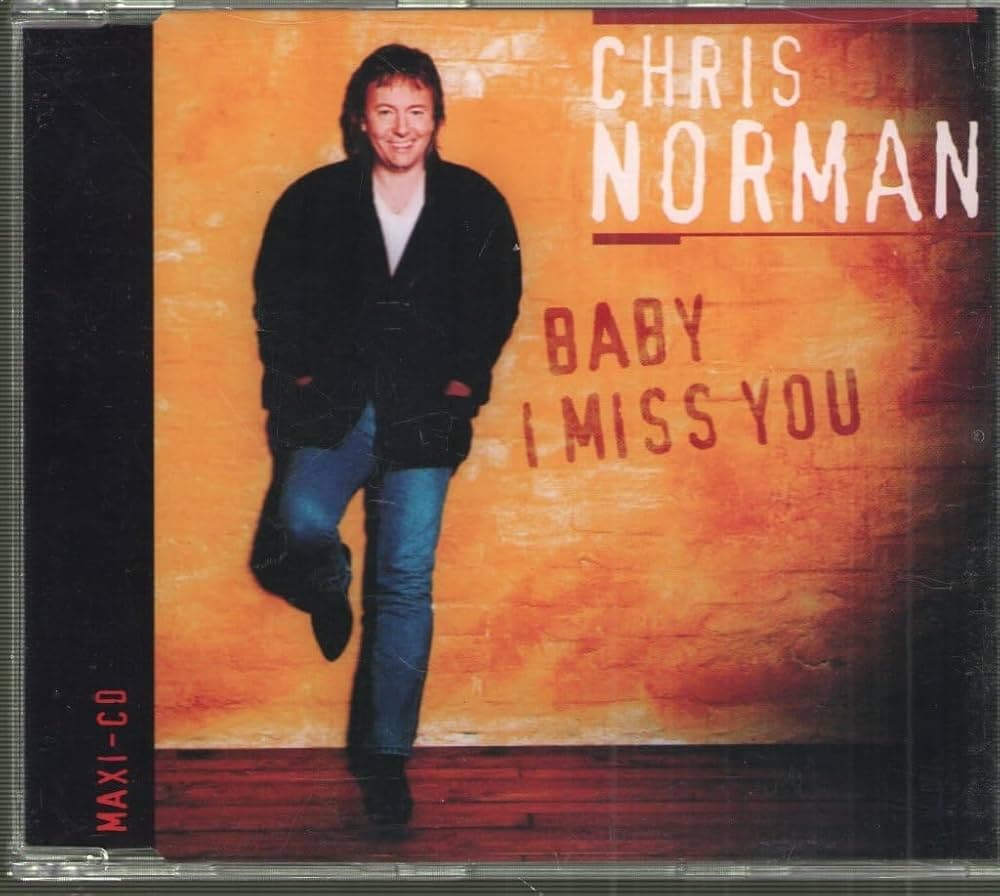
A quiet confession of absence, where longing becomes the song’s only honest currency
Released during Chris Norman’s post-band solo era, Baby I Miss You belongs to a period when his adult-oriented pop ballads were circulating steadily on European radio, reflecting a mature phase of his career rather than a pursuit of chart-dominating spectacle. Issued as a standalone single within his solo catalogue rather than as a defining track from a landmark album, the song arrived without the commercial fanfare that had once accompanied his work with Smokie, yet it carried the unmistakable signature of an artist who understood how intimacy itself could be a form of impact. In this sense, its reception was quieter, measured less by headline chart positions than by its resonance with listeners who had aged alongside Norman’s voice.
What makes Baby I Miss You endure is not a dramatic backstory or a mythologized moment of creation, but the way it distills emotional absence into something almost conversational. The lyric does not posture. It does not attempt clever turns of phrase or symbolic excess. Instead, it leans into repetition and directness, allowing the weight of the sentiment to accumulate naturally. The phrase “I miss you,” repeated with gentle insistence, becomes less a declaration than a state of being, a condition the narrator inhabits rather than escapes.
Musically, the song is built to serve that restraint. The arrangement favors soft keyboards, unobtrusive rhythm, and a melodic structure that avoids sharp contrasts. This is intentional. Chris Norman’s voice, slightly weathered and unmistakably human, is placed front and center, where every inflection matters. By the time he reaches the chorus, the listener is not being persuaded to feel something new but invited to recognize something already familiar. The song succeeds because it refuses to rush grief, longing, or emotional dependence into a tidy resolution.
Within Norman’s broader body of solo work, Baby I Miss You reflects a thematic continuity that defines much of his post-Smokie identity. Where earlier hits thrived on romantic immediacy and youthful yearning, his later recordings often sound like letters written after the moment has passed. This is music for reflection rather than pursuit. The narrator does not ask for reconciliation or promise transformation. He simply acknowledges absence and allows it to speak for itself.
Culturally, the song occupies a space that many classic pop recordings quietly claim: it becomes personal property. Fans rarely discuss it in terms of rankings or accolades. Instead, it surfaces in memories, late-night listening, and private moments of emotional inventory. That is its legacy. Baby I Miss You is not designed to define an era, but to accompany listeners through their own, offering no solution beyond recognition.
In the end, the song stands as a reminder of what Chris Norman has always understood at his best: that sincerity, when delivered without pretense, can outlast volume, fashion, and even charts.