
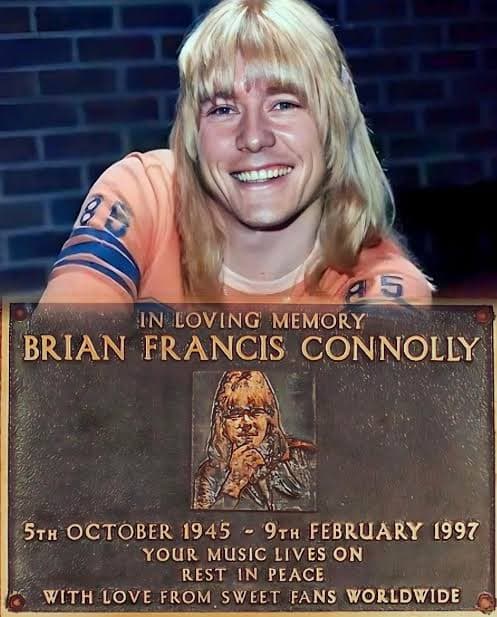
A singular voice that turned glitter into thunder and left British pop forever louder, brighter, and bruised with feeling
In the early 1970s, Brian Connolly stood at the center of Sweet, a band whose singles routinely stormed the UK charts and rewrote the rules of what pop could sound like when it refused to behave. Fronting a run of hits that included UK No. 1 singles and international chart toppers, Connolly’s voice became inseparable from songs like “Block Buster!”, “Hell Raiser”, and “The Ballroom Blitz”, many of them later consolidated on the era-defining album Desolation Boulevard. These records were not merely successful. They were seismic, arriving at a moment when British pop was flirting with glam’s visual excess but had not yet found a voice sharp enough to cut through the spectacle. Connolly provided that voice, equal parts sneer, vulnerability, and melodic discipline.
What distinguishes Connolly’s legacy is not simply the number of hits attached to his name, but the emotional paradox at the heart of his performances. On the surface, Sweet projected chaos: distorted guitars crashing into bubblegum choruses, chants that felt ripped from football terraces, and lyrics that thrived on confrontation. Yet Connolly’s lead vocals often carried an unexpected tenderness. Listen closely to “Fox on the Run”, one of the band’s most enduring international successes, and you hear a singer balancing bravado with a sense of resignation. The song races forward, propelled by stacked harmonies and a relentless beat, but Connolly sings as if already aware of the cost of that momentum. It is pop music aware of its own volatility.
Unlike many glam-era frontmen, Connolly was not merely a stylist or provocateur. His phrasing was precise, his melodic instincts rooted in classic British pop and early rock and roll. Even when Sweet leaned hardest into volume and attitude, there was always a clear melodic spine, and Connolly was its guardian. He knew how to sell a chorus without bludgeoning it, how to inject drama into a line without tipping into parody. That balance is why these songs have endured long after the glitter faded and the platform boots were packed away.
There is also a darker resonance to Connolly’s legacy, one that deepens the emotional weight of Sweet’s catalogue. His later struggles, widely known and inseparable from the band’s history, cast a retrospective shadow over those explosive records. The defiance in “The Ballroom Blitz” now sounds like a battle cry against forces already closing in. The sweetness in the melodies feels more fragile, more human. This is not revisionism; it is the natural outcome of time revealing the cost behind the noise.
Today, Brian Connolly remains closely tied to Sweet’s major hits because his voice was the lens through which their contradictions made sense. He turned carefully constructed pop songs into communal events, gave glam rock a wounded heart, and left behind a body of work that still crackles with urgency. These records do not ask to be remembered politely. They demand to be felt, loudly, the way Connolly always intended.