
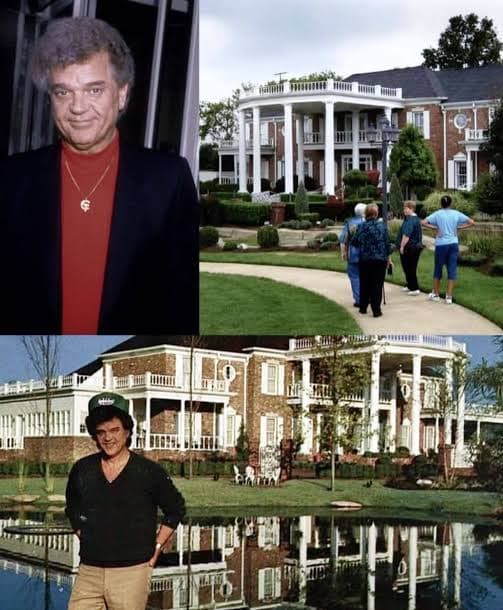
A voice at home with its people, turning a private kingdom into a living country song.
In the 1970s through the 1990s, Conway Twitty was not merely a chart presence but a reigning constant, an artist whose singles repeatedly rose to the top of the country charts while his albums anchored the genre’s commercial and emotional center. Within that long arc of success, his performances at Twitty City in Hendersonville functioned as an unofficial album of lived experience, a place where the man behind the hits brought the full weight of his catalog into an intimate, controlled environment shaped on his own terms. Though these appearances were not issued as a single charting release, they belonged to the same creative continuum as his studio work and touring peak, and they were inseparable from the legacy that made Conway Twitty one of country music’s most durable figures.
To understand what unfolded at Twitty City, one must first understand why it existed. Twitty built the complex as a personal headquarters, part museum, part rehearsal hall, part sanctuary. It was a physical manifestation of an artist who had crossed genres, survived reinvention, and earned the right to define his own space. When he performed there, the songs carried an added gravity. This was not the anonymous glow of a civic arena. This was his ground, his history lining the walls, his audience often made up of fans who felt invited rather than admitted.
Musically, these performances distilled the core of Twitty’s art. His voice, famously supple and conversational, leaned into its strengths in a room that rewarded nuance. He did not need to overpower the listener. A held note, a slight rasp, a pause before a final line could do the work. The material itself, songs of devotion, regret, temptation, and endurance, took on a confessional quality. At Twitty City, the themes that defined his catalog sounded less like performance and more like testimony.
Lyrically, Twitty’s songs have always thrived on proximity. They speak directly to the listener, often in the first person, often with an emotional honesty that borders on vulnerability. In this setting, that directness intensified. The familiar narratives of love tested by time, of men grappling with desire and responsibility, gained credibility from the surroundings. This was a mature artist singing to an audience that had lived alongside these songs for decades. There was no need for irony or reinvention. The power lay in recognition.
Culturally, Twitty City stands as a rare example of an artist consolidating fame into place. These performances reinforced Twitty’s image as both star and steward, a custodian of country tradition who understood that longevity comes from connection rather than spectacle. For listeners and historians alike, the music made there offers insight into how an artist sustains relevance without chasing novelty.
In the end, Conway Twitty at Twitty City represents something deeper than a concert series. It is the sound of an artist fully inhabiting his legacy, singing from within it, and inviting others to step inside.