
Fame Could Shake the Stage, But Family Was the Quiet Place Where Brian Connolly Learned How to Breathe
In the mid nineteen seventies, at the commercial peak of Sweet, Brian Connolly stood at the center of British pop culture, fronting a band whose singles dominated charts and whose image defined the era. By 1974, Sweet had already secured multiple UK Top Ten hits and international success, with albums such as Desolation Boulevard cementing their status as more than a singles act. Connolly was not merely the lead singer, he was the emotional anchor of the band, his high, expressive voice cutting through layers of glam polish with unmistakable human urgency. Yet behind the public spectacle, there existed a quieter life shaped by his wife Marilyn and their first daughter Nicola, a family presence that grounded him during the most turbulent years of fame.
Connolly’s role in Sweet was both central and paradoxical. While the band was often framed as a high energy glam rock machine, their most enduring songs relied on vulnerability, melodic clarity, and emotional directness, all of which flowed through Connolly’s vocals. Tracks like “Ballroom Blitz” and “Fox on the Run” carried theatrical force, but beneath the glitter was a singer whose phrasing conveyed strain, longing, and resilience. Connolly sang not as a caricature of glam excess, but as a working class Scot navigating sudden stardom. That tension between spectacle and sincerity became one of Sweet’s defining traits.
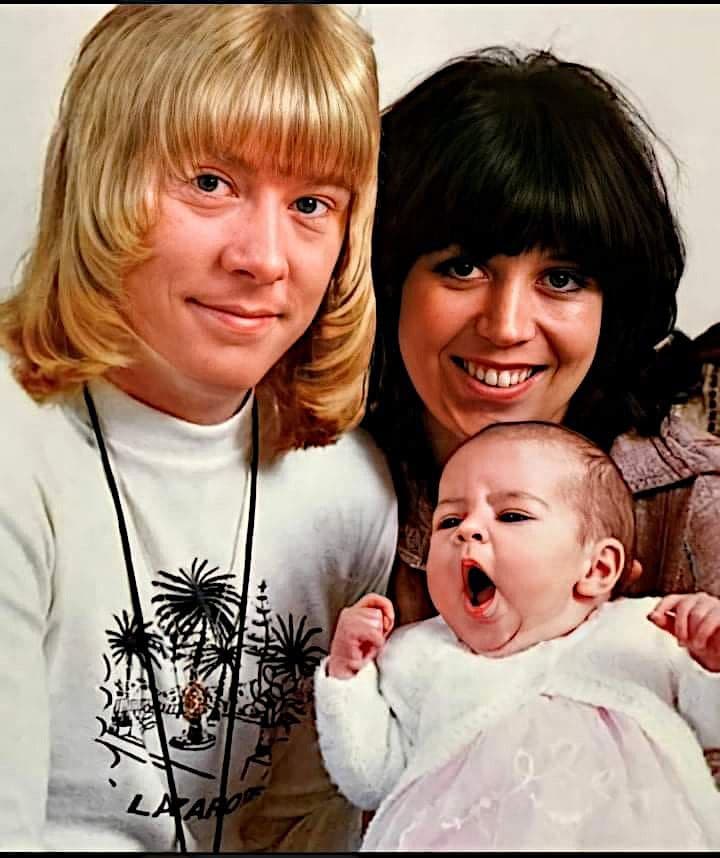
At home, however, Connolly occupied a different register entirely. Photographs from 1974 showing him with Marilyn and young Nicola reveal a man temporarily removed from amplifiers and spotlights. His expression softens, the bravado dissolves, and what remains is a father and husband attempting to preserve something stable in a life that rarely stood still. This domestic counterweight mattered. Touring schedules were punishing, media pressure relentless, and internal band dynamics increasingly strained. Family offered Connolly a sense of continuity that the music industry could not provide.
As Sweet evolved musically, moving toward heavier rock textures and more self authored material, Connolly’s importance only grew. His voice adapted, weathered slightly by years on the road, yet deepened in character. Even as personal struggles began to surface later in the decade, his performances retained an emotional honesty that fans instinctively trusted. The tragedy of Connolly’s later years has often overshadowed the fullness of his contribution, but during the classic Sweet period, his artistry was inseparable from the band’s success.
To understand Brian Connolly fully, one must hold both images at once. The commanding frontman driving choruses that echoed across stadiums, and the young father holding his daughter in a moment untouched by applause. His legacy lives not only in chart positions or hit compilations, but in the fragile balance he tried to maintain between public triumph and private meaning. In that balance lies the true story of a voice that carried joy, pressure, and humanity in equal measure.