
A restless soul wandering between faith and doubt, asking not for answers but for direction.
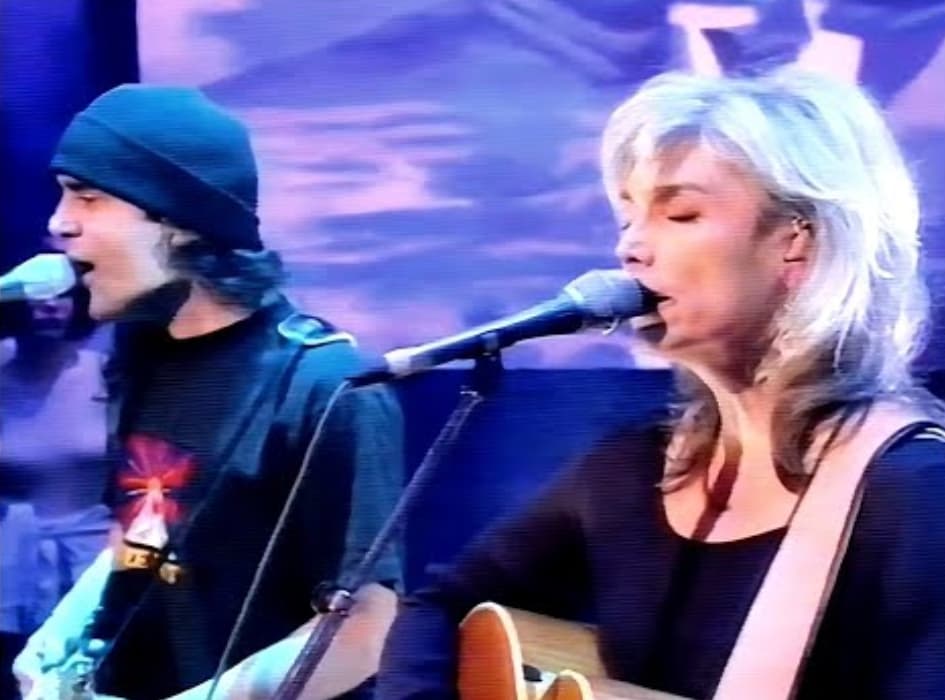
When Emmylou Harris released “Where Will I Be” in 1995, it arrived not as a commercial thunderclap but as a quiet reckoning. The song appeared on Wrecking Ball, her collaboration with producer and co writer Daniel Lanois, an album that would later be recognized as one of the most transformative works of her career. Upon release, the record performed solidly on the country charts and reached a wider critical audience far beyond Nashville, signaling that something fundamental had shifted in Harris’s artistic path. Though “Where Will I Be” charted modestly as a single, its real impact unfolded over time, carried by performances such as the stark and searching live rendition with Daniel Lanois at the BBC in London in 1995.
The song itself is built on motion rather than resolution. Written by Daniel Lanois, “Where Will I Be” is not concerned with destinations but with the unease of travel, spiritual, emotional, and existential. Harris does not sing as a narrator looking back with clarity. She sings from inside the question. The lyrics move through images of highways, hunger, belief, and weariness, yet they resist narrative closure. There is no promise of arrival. Only the continued act of moving forward.
What makes this piece endure is its restraint. Lanois’s production on Wrecking Ball was famously atmospheric, steeped in reverb, space, and shadow, but “Where Will I Be” stands out for how gently it balances uncertainty with faith. Harris’s voice, long associated with crystalline harmonies and traditional forms, is placed here in a more vulnerable register. She sounds weathered but alert, like someone who has learned that survival does not guarantee understanding.
The BBC performance in 1995 sharpens this emotional core. Stripped of studio polish, the song becomes almost devotional. Harris and Daniel Lanois share the space as equals, not star and accompanist but fellow travelers. The pauses feel intentional. Silence becomes part of the lyric. Each line lands with the weight of lived experience rather than performance.
Culturally, “Where Will I Be” marks a turning point for Emmylou Harris. It signaled her willingness to step away from genre expectations and into a more ambiguous, adult space where doubt was not a weakness but a source of truth. For listeners, the song offered permission to sit with uncertainty without shame. It spoke to aging, belief, and endurance in a way few country songs of the era dared to attempt.
Decades later, “Where Will I Be” still resonates because it refuses to resolve its central question. It understands that some songs are not meant to guide us home. They are meant to walk beside us, asking quietly, again and again, as the road keeps unfolding.