
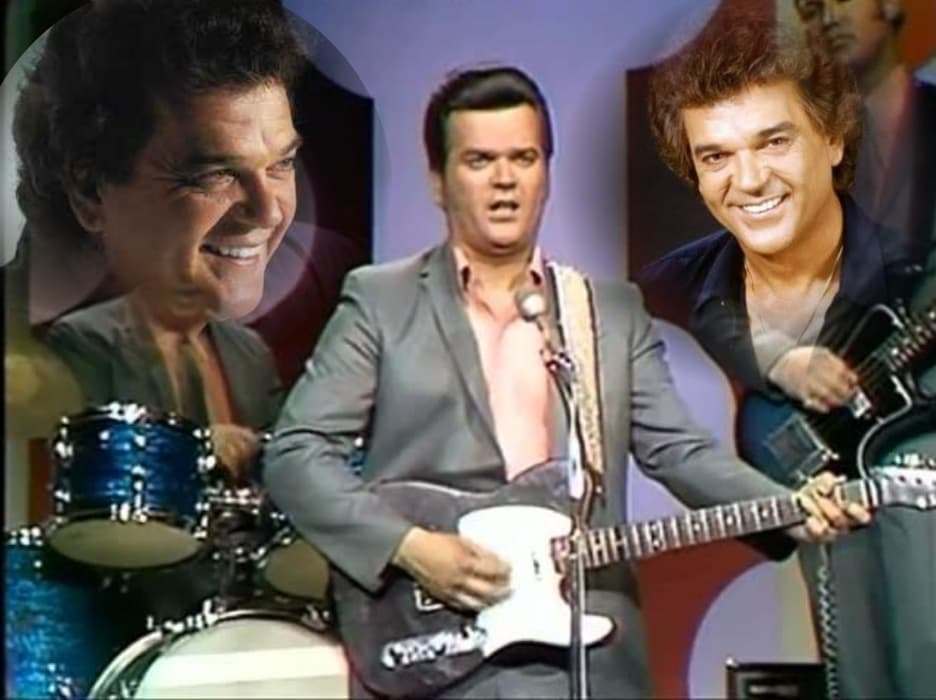
A man standing alone in the quiet after love has slipped away, speaking not to reclaim it but to honor what it once was.
When Conway Twitty released Hello Darlin’ in 1970, the song rose swiftly to the summit of the Billboard Hot Country Singles chart, claiming the No. 1 position and reaffirming Twitty’s dominance in country music at the dawn of the decade. It appeared on the album Hello Darlin’, a record that further solidified his transition from rock and pop success into a uniquely intimate country voice. By the time Twitty performed the song live on The Johnny Cash TV Show in 1971, Hello Darlin’ was already a modern standard, familiar to audiences not as a novelty hit but as a shared emotional experience.
What makes Hello Darlin’ endure is not complexity of narrative, but the courage of its simplicity. The song opens not with melody, but with spoken words. “Hello darlin’, nice to see you.” In that moment, Twitty disarms the listener. There is no dramatic flourish, no poetic abstraction. Just a man addressing the person who once defined his emotional world. The spoken introduction functions like a confession overheard rather than a performance delivered. When the melody finally enters, it feels less like a song beginning and more like emotion catching its breath.
The lyrical power of Hello Darlin’ lies in its refusal to seek redemption or reunion. This is not a plea for forgiveness, nor a declaration of undying hope. Instead, it is a reckoning. The narrator acknowledges his failures, accepts responsibility, and offers affection without expectation. That restraint is its quiet triumph. In a genre often defined by heartbreak expressed through anger or regret, Twitty presents maturity. Love, here, is not diminished by loss. It is clarified by it.
Musically, the arrangement supports this emotional posture with remarkable discipline. The tempo is unhurried, allowing every phrase to linger. The instrumentation stays warm and understated, never intruding on Twitty’s vocal phrasing. His voice is controlled, almost conversational, yet rich with subtext. Each pause feels intentional. Each held note carries the weight of things left unsaid. This is singing as emotional architecture, carefully balanced so that nothing collapses under its own sentiment.
The 1971 performance on The Johnny Cash TV Show adds another layer of resonance. In that setting, stripped of studio polish and framed by Cash’s own reverence for authenticity, Hello Darlin’ becomes something closer to testimony. Twitty does not perform outwardly. He performs inwardly. The camera captures not spectacle but stillness, a man alone with a memory he has learned to live beside rather than conquer.
Decades later, Hello Darlin’ remains one of country music’s most devastatingly honest statements. It endures because it understands something timeless. That love does not always end in reconciliation, and that dignity can exist even in loss. In giving voice to that truth, Conway Twitty created not just a hit, but a moment of shared human recognition that continues to echo long after the final note fades.