
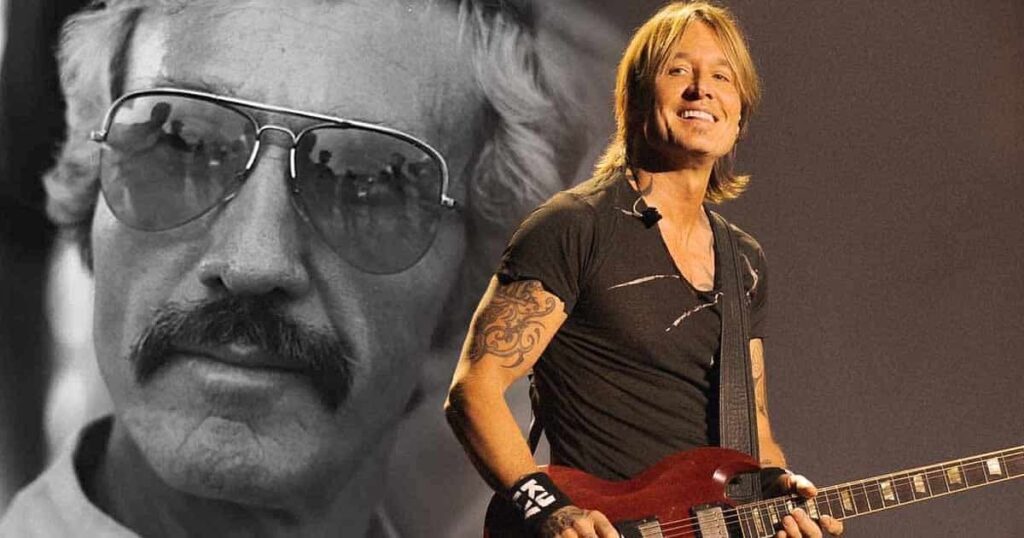
Modern Virtuoso Bows to a Western Balladeer, Bridging Generations Through Song
In a stirring live tribute, Keith Urban honored the enduring legacy of Marty Robbins with a medley of the latter’s most iconic songs, reintroducing classics from the landmark 1959 album Gunfighter Ballads and Trail Songs to a contemporary audience. That album, a towering achievement in American country and western music, produced “El Paso,” which reached No. 1 on the Billboard Hot 100 in 1960 and won the Grammy Award for Best Country & Western Recording. By weaving selections from Robbins’ celebrated catalog into a single performance, Urban did more than revisit chart history; he rekindled the mythic, windswept spirit that defined Robbins’ artistry.
Robbins was never merely a country singer. He was a narrative architect, a composer of widescreen morality tales set against desert horizons and saloon doorways. Songs like “Big Iron” and “El Paso” unfolded with cinematic pacing, their galloping rhythms and Spanish-tinged guitar lines evoking a frontier both romanticized and perilous. His voice, supple yet resolute, carried the fatalism of a man who understood that honor and heartbreak often rode the same trail.
Urban’s decision to present a medley rather than a single selection is telling. A medley compresses time. It suggests lineage. It acknowledges that Robbins’ work is not confined to one definitive hit but forms a cohesive mythology. Urban, himself a virtuoso guitarist with a deep reverence for classic songcraft, approached the material not as an imitator but as an interpreter. His phrasing nodded to Robbins’ clarity of diction, yet his guitar work bore the polished intensity of modern arena country. In that fusion, one hears the evolution of the genre itself.
The emotional resonance of the tribute lies in its recognition that Robbins’ songs are not relics. They remain alive because their themes are elemental: love pursued at any cost, justice delivered in lonely streets, destiny sealed by a single decision. In “El Paso,” the protagonist’s fatal return to Feleena is not merely a plot twist; it is an operatic surrender to longing. In “Big Iron,” the stranger with the gleaming revolver embodies mythic righteousness. These are archetypes, etched into American musical consciousness.
Urban’s homage underscores how profoundly Robbins shaped the grammar of country storytelling. The narrative ballad, the dramatic modulation, the careful orchestration that balanced Nashville polish with Southwestern color—these innovations reverberate through generations. By stitching Robbins’ songs together in a single, reverent arc, Urban affirmed that the past is not distant. It is a living current, flowing through every chord struck on a modern stage.
For listeners attuned to country music’s lineage, the medley was more than entertainment. It was a reminder that beneath the gloss of contemporary production lies a foundation built by troubadours like Robbins—artists who dared to treat a three-minute single as epic literature. In honoring him, Urban did not merely look back. He illuminated the road that brought country music to the present, and perhaps, pointed quietly toward its future.