
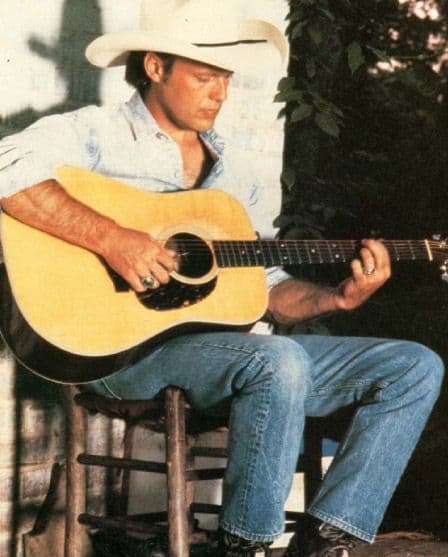
Vow of Final Sorrow, Where Heartbreak Turns into Resolve
When Ricky Van Shelton released “I’ve Cried My Last Tear For You” in 1990, it became the defining statement of emotional emancipation in his catalog, soaring to No. 1 on the Billboard Hot Country Singles & Tracks chart. The song appeared on his third studio album, RVS III, a record that cemented Shelton’s place among the neotraditional torchbearers who revitalized country music at the close of the 1980s. By the time this single reached radio, Shelton was already recognized for his rich baritone and his allegiance to the genre’s classic emotional grammar. Yet this performance felt different. It did not simply ache. It resolved.
At first glance, the premise is familiar terrain: a lover wounded past endurance, announcing an end to sorrow. But Shelton’s delivery transforms a conventional declaration into something almost ceremonial. The title itself is a thesis. This is not the first tear, nor the second. It is the last. The lyric charts a psychological journey from humiliation to clarity, from pleading to detachment. Where earlier country laments often lingered in the comfort of shared misery, “I’ve Cried My Last Tear For You” stands as a line drawn in emotional sand.
The song’s architecture reinforces this evolution. Built on a steady mid-tempo rhythm and anchored by clean, traditional instrumentation, it leaves ample space for Shelton’s voice to articulate the interior shift. There is restraint in the arrangement. Steel guitar weaves through the verses like memory itself, but it never overwhelms the central narrative. The production reflects the neotraditional ethos of the era, honoring the sonic lineage of George Jones and Merle Haggard while embracing a contemporary polish that made it radio-ready for 1990 audiences.
What distinguishes Shelton’s performance is the dignity he lends to heartbreak. He does not rage. He does not collapse. Instead, he sings as a man who has tallied his suffering and chosen self-respect. In the climactic moments, his phrasing carries a subtle steeliness, a quiet insistence that the emotional accounting is complete. The finality in his tone feels earned rather than theatrical.
Within the broader arc of Shelton’s career, this song represents a crystallization of his artistic identity. He was never the flamboyant rebel nor the crossover showman. He was the interpreter of classic sentiment, the custodian of country’s emotional directness. With “I’ve Cried My Last Tear For You,” he gave voice to a universal rite of passage: the instant when grief exhausts itself and self-preservation takes its place.
Three decades on, the song endures not because it dramatizes sorrow, but because it dignifies the decision to move beyond it. In country music’s vast archive of tears, this one stands as a testament to the power of the last one.