
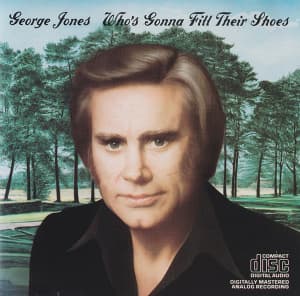
A grieving salute to fading legends where country music pauses to ask what remains after its greatest voices fall silent
When George Jones released Who’s Gonna Fill Their Shoes in 1985 as the title track from the album Who’s Gonna Fill Their Shoes, the song quickly rose to the top of the Billboard Hot Country Singles chart and became one of the defining statements of his later career. Yet its significance reached far beyond commercial success. By the mid-1980s, country music was undergoing rapid transformation, balancing traditional roots against increasing commercialization and crossover ambitions. In that atmosphere, Jones delivered something both reflective and quietly confrontational. A reminder that country music’s soul had been built by voices whose emotional honesty could not easily be replaced.
At its heart, Who’s Gonna Fill Their Shoes functions as both tribute and warning. The song names towering figures such as Hank Williams, Lefty Frizzell, Merle Haggard, Elvis Presley, and Patsy Cline, not simply to celebrate nostalgia, but to emphasize the weight of inheritance within country music itself. These artists are presented less as celebrities than as foundational spirits whose artistry shaped the emotional language of the genre.
What makes the song especially powerful is that George Jones himself belonged within that same lineage even as he sang about it. By 1985, Jones had already endured decades of personal turmoil, artistic triumph, addiction, survival, and redemption. His voice carried the scars of lived experience so deeply that every line sounded earned rather than performed. When he asks who will fill the shoes of country music’s departed giants, the question feels genuine because he understood exactly how rare such authenticity truly was.
Vocally, Jones delivers the song with remarkable restraint. He does not approach it with grand patriotic force or sentimental exaggeration. Instead, his phrasing carries a mixture of admiration, sadness, and uncertainty. There is pride in the traditions being honored, but also anxiety about what may be disappearing. This emotional complexity elevates the song beyond simple tribute into cultural reflection.
Musically, the arrangement remains rooted in classic country structure. Steel guitar, measured rhythms, and uncluttered instrumentation create an atmosphere of dignity and continuity. The production avoids excessive polish, allowing the emotional core of the lyric to remain central. This simplicity becomes essential because the song depends entirely on sincerity.
Lyrically, Who’s Gonna Fill Their Shoes speaks not only to country music, but to the broader human fear of cultural erosion. Every generation eventually watches its defining voices fade away, leaving behind the unsettling realization that influence alone cannot guarantee replacement. Talent can be imitated. Spirit cannot.
The timing of the song’s release also gave it additional emotional resonance. By the mid-1980s, many listeners already viewed traditional country music with a growing sense of nostalgia. Jones understood this instinctively. Rather than resisting change outright, he simply posed a question that carried profound emotional weight. Can artistry rooted in truth survive within an industry increasingly shaped by image and commerce?
What lingers after the song ends is not despair, but reverence. A recognition that great music leaves behind standards almost impossible to replicate because it emerges from unique combinations of pain, character, and lived experience.
And as George Jones sings those unforgettable lines with weary conviction, he unknowingly becomes part of the very legacy he is mourning. One more irreplaceable voice asking who will remain once the echoes of the masters begin to fade.