
A Song About Longing Became a Moment of Resurrection Under the Stage Lights
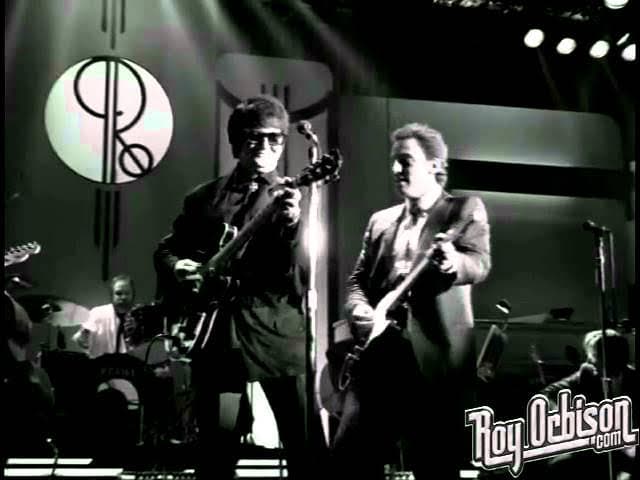
When Roy Orbison stepped onto the stage for Black and White Night in 1987, the performance carried far more weight than nostalgia. Broadcast the following year and later released as the celebrated live album Black and White Night, the concert marked one of the great late-career resurrections in American music. Among its many unforgettable moments, “Dream Baby” arrived like a sudden burst of sunlight through memory itself. Originally a Top 10 hit for Roy Orbison in 1962, the song had already secured its place in the early rock and roll canon, climbing to No. 4 on the Billboard Hot 100 during the height of Orbison’s first commercial peak. But in this performance, decades removed from its original release, the song no longer sounded like the restless optimism of youth. It sounded like survival.
There is something uniquely poignant about hearing Roy Orbison sing “Dream Baby” in the context of Black and White Night. The original recording was buoyant and rhythmic, driven by that unmistakable early-60s pulse that sat somewhere between rockabilly and pop sophistication. Written by Cindy Walker, one of country music’s finest songwriters, the song is deceptively simple on paper. A man dreams of a woman each night and waits for her return. Yet Orbison always understood how to turn simplicity into emotional gravity. He never sang longing as performance. He sang it as condition.
By the time of Black and White Night, Orbison’s life had been marked by extraordinary personal tragedy and long professional exile. The deaths of his wife Claudette and later two of his sons had cast a shadow over nearly every retrospective understanding of his music. Even songs that once sounded carefree seemed to carry hidden bruises. That is part of what makes “Dream Baby” so affecting in this concert film. He sings it with warmth, but also with the quiet authority of someone who has outlived entire eras of his own life.
The arrangement itself remains remarkably faithful to the original spirit of the song, but the atmosphere transforms it. Surrounded by an extraordinary ensemble that included Bruce Springsteen, Elvis Costello, Tom Waits, k.d. lang, Bonnie Raitt, and Jackson Browne, Orbison stands at the center almost motionless, dressed in black, barely gesturing, allowing the voice to command everything. The contrast is striking. Younger artists around him radiate visible excitement, while Orbison performs with an almost statuesque calm. It reinforces what many musicians had long believed: that his voice existed outside ordinary categories of rock performance.
And that voice during “Dream Baby” remains astonishing. Even after years away from mainstream prominence, Orbison’s phrasing retains its crystalline precision. He stretches syllables with operatic control, turning ordinary lines into emotional echoes. Unlike many rock singers who relied on force or swagger, Orbison specialized in vulnerability. He could make yearning sound noble rather than weak. That emotional architecture became one of the defining blueprints for generations of singers who followed him.
What gives the Black and White Night version of “Dream Baby” its enduring power is not merely technical excellence or historical importance. It is the visible sense of rediscovery unfolding in real time. The audience is not simply hearing a classic song. They are witnessing an artist reclaim his own mythology after years of being underestimated by the industry that once celebrated him. Every applause break feels less like routine appreciation and more like collective recognition.
In hindsight, the concert now feels almost sacred within the history of popular music. Orbison would pass away only a year later in 1988, making performances like “Dream Baby” resonate with even deeper emotional finality. Yet nothing about the performance feels mournful. If anything, it radiates renewed life. The song that once captured youthful romantic dreaming became, in Orbison’s later years, something far greater: proof that certain voices never truly disappear.