
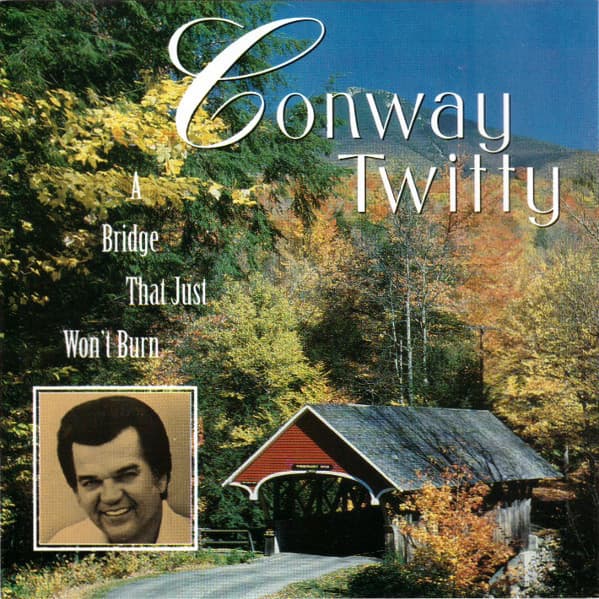
A meditation on love that refuses to collapse, even when every fire has already been lit beneath it.
Released at the close of 1980, A Bridge That Just Won’t Burn by Conway Twitty arrived as both a commercial triumph and a quiet emotional reckoning. Issued as the title track from the album A Bridge That Just Won’t Burn, the song rose to Number 1 on the Billboard Hot Country Singles chart, extending Twitty’s extraordinary run of chart dominance and reaffirming his unmatched ability to turn adult vulnerability into popular art. By this point in his career, Twitty was no longer chasing hits. He was curating truths. This record stands as one of his most revealing statements about emotional endurance and the quiet failures of resolve.
At its core, A Bridge That Just Won’t Burn is a study in human contradiction. The narrator is not pleading for love to survive, nor celebrating its resilience. Instead, he is trapped in the uncomfortable space between intention and instinct. He knows the relationship should end. Every rational argument has been made. Every reason to walk away is understood. And yet the bridge, that symbolic crossing between two people, refuses to collapse. No matter how many times it is tested, scorched, or abandoned, it remains standing.
What gives the song its lasting power is Twitty’s restraint. Vocally, he avoids melodrama. His baritone is calm, almost conversational, carrying the weight of someone who has already accepted his own emotional weakness. This is not the voice of a young man discovering heartbreak. This is the voice of someone who knows better and still cannot do better. That distinction is crucial. Twitty built much of his legacy on songs that spoke directly to adult listeners, people who recognized themselves in flawed decisions and unresolved attachments.
Musically, the arrangement mirrors the lyric’s tension. The production is smooth and measured, with steel guitar lines that hover rather than cry, and a rhythm section that moves steadily forward without urgency. Nothing rushes. Nothing explodes. The song simply exists in a state of emotional suspension, much like the relationship it describes. That sense of inevitability is what makes the chorus land so deeply. The bridge does not burn because the heart will not let it.
Within the broader arc of Twitty’s career, this song feels like a late night confession rather than a grand statement. By 1980, he had already secured his place as one of country music’s most reliable hitmakers. What he was refining here was intimacy. A Bridge That Just Won’t Burn does not offer resolution or redemption. It offers recognition. It tells the listener that knowing the right thing to do does not always grant the strength to do it.
Decades later, the song endures because its truth has not aged. Love, especially the kind built over years, rarely ends cleanly. Some connections linger, stubborn and uncharred, long after the flames should have done their work. In capturing that reality with such quiet precision, Conway Twitty left behind not just another Number 1 record, but a mirror for anyone who has ever tried and failed to walk away.