
A declaration of youthful defiance where rhythm becomes identity and confidence walks louder than consequence.
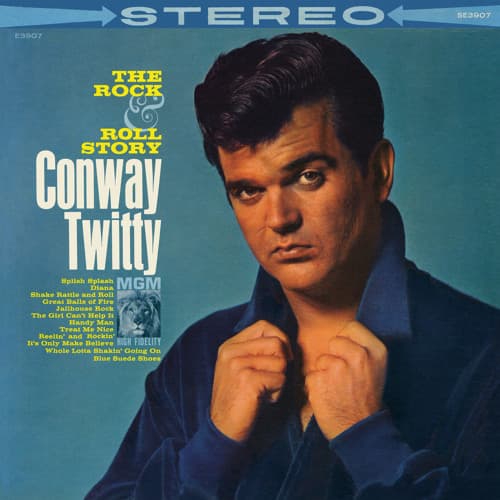
When Conway Twitty cut his version of Blue Suede Shoes, it arrived without the chart-dominating impact that defined earlier rock-and-roll breakthroughs, and it never rivaled the commercial explosion associated with the song’s first wave of success. Yet its life in Twitty’s catalog has endured, preserved through his early rockabilly period and later collected on retrospectives such as Rock ’n’ Roll Years, reminding listeners that chart position is only one measure of cultural permanence. Before he became synonymous with country music’s emotional candor, Conway Twitty was still chasing the pulse of postwar youth, and Blue Suede Shoes stands as a vivid document of that restless ambition.
Originally written and popularized by Carl Perkins, Blue Suede Shoes had already established itself as a manifesto of 1950s independence before Twitty ever approached it. What makes Twitty’s interpretation compelling is not novelty, but perspective. At this stage of his career, he was navigating the uncertain space between raw rock-and-roll aspiration and the polished storyteller he would later become. His performance does not attempt to outshout the song’s legacy. Instead, it leans into momentum, revealing an artist testing how much swagger his voice could carry without tipping into caricature.
Lyrically, Blue Suede Shoes is deceptively simple. Its central demand, delivered with playful menace, elevates a mundane object into a symbol of selfhood. The shoes are not about fashion. They are about boundaries. In Twitty’s hands, this boundary feels less like rebellion for rebellion’s sake and more like a young man’s insistence on dignity in a world eager to trample it. The song’s repetition becomes hypnotic, a chant that reinforces identity through rhythm rather than argument. You do not debate the narrator. You feel him moving.
Musically, Twitty’s vocal phrasing hints at what would later define his greatness. Even here, in a genre built on speed and bravado, there is restraint. His tone is confident but never reckless, grounded in a sense of control that separates performance from panic. The backing rhythm drives forward relentlessly, yet Twitty remains centered, suggesting an intuitive understanding of space and timing that would become essential to his country recordings years later.
The cultural significance of Blue Suede Shoes within Conway Twitty’s story lies precisely in its transitional nature. It captures a moment before categorization hardened, when artists could still wander between genres in search of their truest voice. Listening now, the track feels like a photograph taken mid-stride. You can see where he has been, and you can almost sense where he is headed.
In retrospect, Blue Suede Shoes is not a detour in Twitty’s career. It is a foundation. It shows that long before he mastered heartbreak and intimacy, he understood attitude, presence, and the power of a simple declaration. Some songs do not need to climb charts to leave a mark. They only need to keep walking.