
In Quiet Longing, a Heartbeat Speaks Louder Than All the World’s Glitter
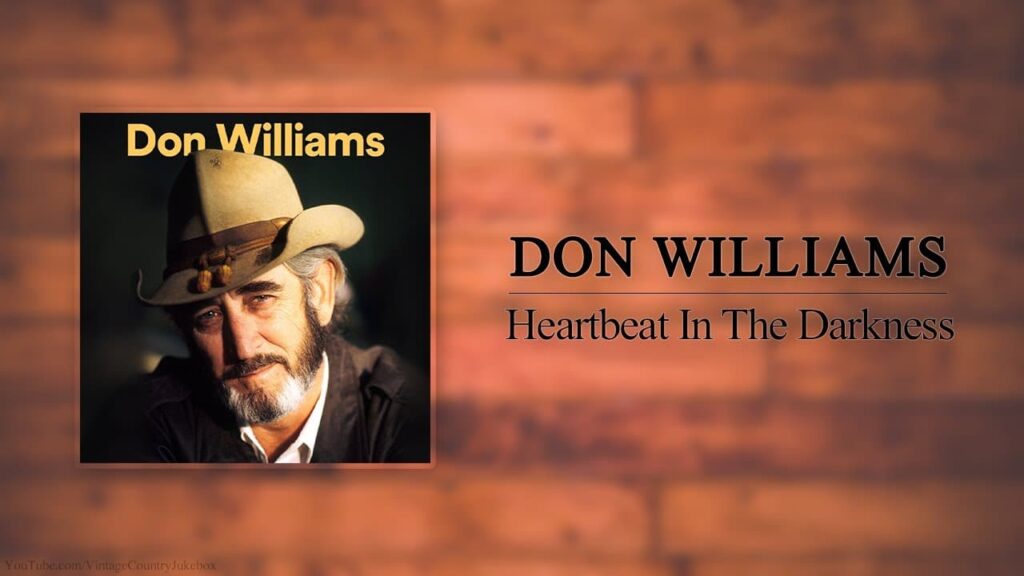
When Don Williams released “Heartbeat in the Darkness” in May 1986, it became more than just another country single—it was his seventeenth and final No. 1 on the Billboard Hot Country chart, holding that peak for one week while lingering on the chart for thirteen weeks. Taken from his album New Moves, this song marked a poignant high point in the career of the gentle giant of country music.
In its simplest form, “Heartbeat in the Darkness” is a meditation on what really matters—a love so profound and enduring that it outshines every material temptation. Written by Dave Loggins and Russell Smith, the song rejects the trappings of wealth and status: “Cadillac smiles in the latest styles … a hundred dollar bill … but it ain’t no good to me.” Williams’ delivery is emblematic of everything he embodied in his artistry: calm, thoughtful, and suffused with a quiet authority as he looks for something real, something lasting.
Musically, the track gives Williams room to breathe. Backed by production from himself and Garth Fundis, the arrangement is understated, allowing his smooth baritone to remain at the center. But, as noted by critics, there is a subtle sophistication here—an unexpected touch of jazz or brass creeping in toward the end, lending a sophistication and nuance that elevate what might otherwise have been a straight-ahead country ballad.
Lyrically, the song’s heart lies in its longing. Williams isn’t chasing diamonds or mansions; he explicitly refuses “a woman tryin’ to find a diamond mine,” and he dismisses the idea of a “mansion on the hill.” What he yearns for instead is the simple, unadorned heartbeat of the person he loves—“every night of my life … next to mine.” It’s an admission that real security, the kind that holds firm when the lights go off and the world fades away, comes not from possessions but from presence.
There’s also a philosophical undertone here, a moral clarity that reflects Williams’ broader body of work: life is not about accumulation, but about authentic connection. The chorus is not a loud declaration but a whisper, a confession: he would trade “every material thing I own in this life” if only he could hear that heartbeat in the darkness.
Culturally, the song resonates as a late-career testament. By the mid-80s, the music world was increasingly dominated by flashy production and commercial ambition, yet Williams held on to his gentler mode. That this was his final No. 1 feels almost symbolic: the man who sang of timeless love, of quiet certainty, ended his run at the very top by reaffirming what he had always stood for.
In the end, “Heartbeat in the Darkness” is neither grandiose nor flamboyant—it is a quiet prayer, a deeply felt reminder that the truest light in one’s life often flickers in the darkness, carried by the steady, reassuring pulse of someone who truly cares.