
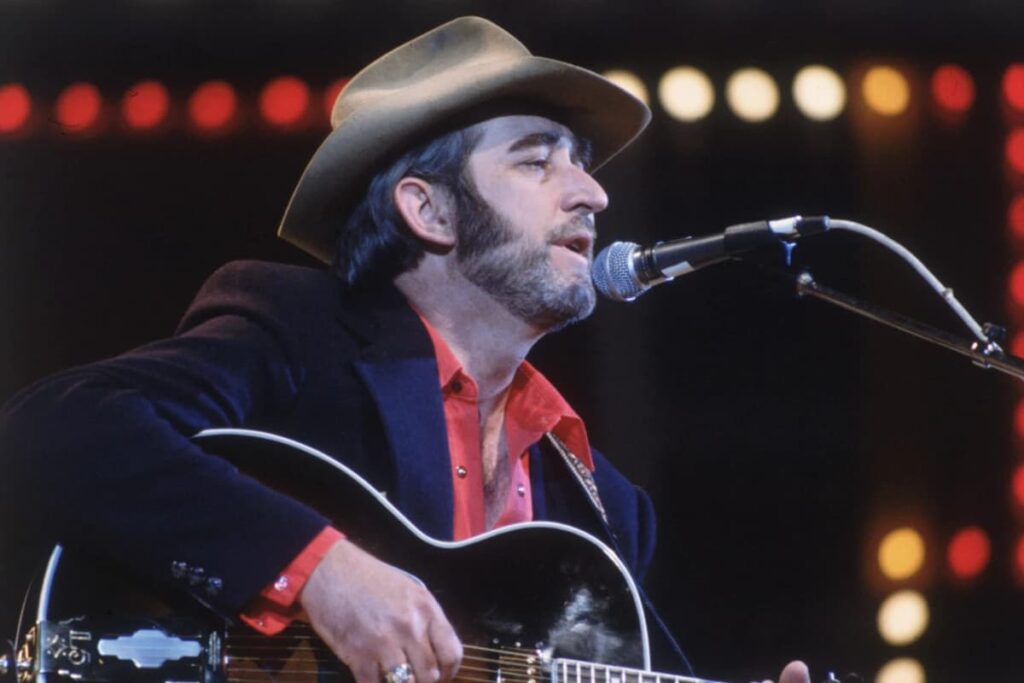
A quiet giant standing beneath the lights, proving that sincerity can command a stage more powerfully than spectacle ever will
By 1989, when Don Williams appeared in performances associated with On Stage 1989, he had already secured his place as one of country music’s most dependable and deeply respected artists. Decades of chart success through albums such as Expressions, Especially for You, and One Good Well had established him not merely as a hitmaker, but as a voice audiences trusted. Unlike many performers entering the later stages of long careers, Williams did not rely on reinvention or theatrical reinvigoration to sustain relevance. His strength remained exactly where it had always been. In calm emotional honesty delivered with unwavering restraint.
The late 1980s represented a fascinating period in country music. Production styles were becoming larger, commercial crossover ambitions increasingly visible, and stage presentation more elaborate. Yet Don Williams stood apart from much of that movement. Watching him perform in 1989 feels almost radical in its simplicity. There is no frantic effort to dominate the stage, no exaggerated persona demanding attention. Instead, Williams walks into the performance with the quiet assurance of someone who understands that the songs themselves already carry enough emotional weight.
This is what makes On Stage 1989 so compelling. The performance reveals how completely Williams trusted stillness. While many artists depended on spectacle to generate emotional connection, he achieved intimacy through patience. His measured pacing, relaxed delivery, and understated stage presence created an atmosphere where listeners leaned inward rather than being overwhelmed outward.
Vocally, his baritone remained remarkably intact during this period. Warm, steady, and deeply human, the voice carried the same reassuring quality that had defined classics like I Believe in You, Tulsa Time, and Amanda. Yet in live performance, those songs often gained an added layer of emotional realism. Time had settled into the voice slightly, adding texture without diminishing clarity. The effect was not decline, but deepening.
Musically, the arrangements reflected Williams’ lifelong artistic discipline. The instrumentation remained elegant but restrained. Acoustic guitars, gentle rhythms, subtle steel guitar textures, and unobtrusive accompaniment created space rather than clutter. This balance allowed the emotional center of each song to remain intact. Nothing distracted from the storytelling.
What becomes especially evident during On Stage 1989 is Williams’ extraordinary ability to communicate emotional truth without theatrical emphasis. Songs about love feel grounded rather than idealized. Songs about loneliness feel reflective rather than tragic. Even moments of heartbreak carry dignity. He understood that audiences often connect more deeply to understatement than exaggeration.
There is also something culturally revealing about revisiting performances like this decades later. In an entertainment landscape increasingly shaped by speed, image construction, and emotional overstatement, Williams’ calm presence feels almost timeless. He represents a tradition of performers who valued consistency over reinvention and emotional clarity over spectacle.
The live setting amplifies another essential quality of Don Williams’ artistry. Generosity. He never appears to perform at the audience. Instead, he performs for them. The atmosphere becomes communal, rooted in shared recognition rather than celebrity distance.
And as the stage lights settle softly around him in On Stage 1989, one truth becomes unmistakable. Don Williams did not need to transform himself into a larger-than-life figure to leave a lasting mark on country music. His greatness came from the opposite instinct entirely. The courage to remain simple, honest, and unmistakably human in an industry often drawn toward noise instead of truth.