
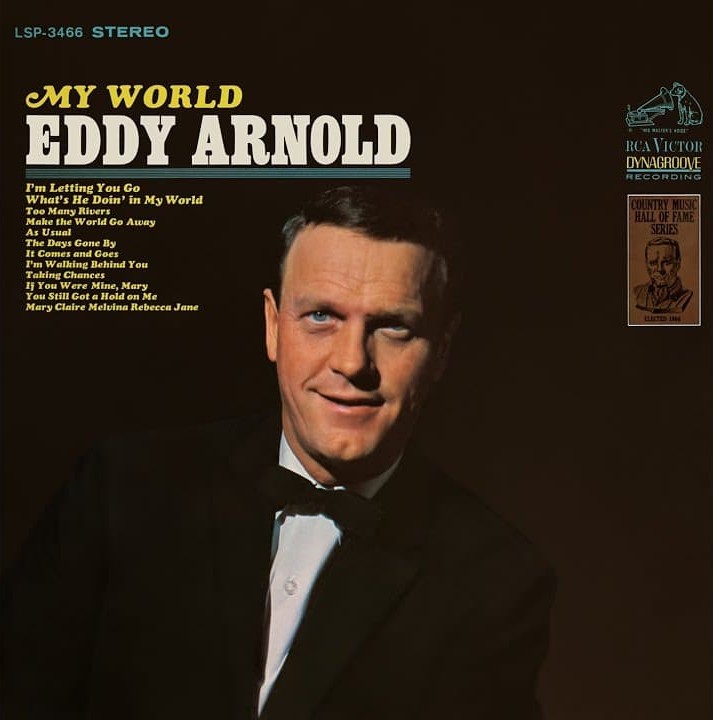
Quiet plea to shut out the noise of a world that never stops demanding
When Eddy Arnold released Make The World Go Away in 1965, the song quickly rose to the top of the Billboard Hot Country Singles chart and crossed over to the pop audience, reaching the Top 40 on the Billboard Hot 100. It became the title track of his album Make The World Go Away, marking one of the most commercially and artistically significant moments of his late career. By that point, Arnold was already a towering figure in country music, yet this recording reaffirmed his relevance in a changing musical landscape and introduced his voice to a new generation of listeners.
At its heart, Make The World Go Away is built on restraint rather than drama. Written by Hank Cochran, the song does not ask for reconciliation, forgiveness, or even love in a conventional sense. Instead, it makes a smaller, more human request. The narrator asks only for temporary shelter from the world and its pressures. The lyrics unfold like a whispered confession, acknowledging emotional exhaustion without turning it into spectacle. This refusal to overstate its pain is precisely what gives the song its lasting power.
Arnold’s interpretation is essential to the song’s meaning. By the mid nineteen sixties, his voice had softened, gaining a conversational intimacy that contrasted with the more declarative style of his early hits. He sings not as a man pleading on bended knee, but as someone who understands his limitations and accepts them. The arrangement, guided by the polished Nashville Sound, frames his voice with gentle strings and a steady rhythm that never intrudes. Nothing rushes. Nothing competes for attention. The music seems designed to step back, allowing the emotional center to remain exposed and unguarded.
Lyrically, the song speaks to a universal impulse. There are moments when love is not about passion or permanence, but about silence. The line asking for the world to be made to go away is not escapist fantasy. It is a recognition that intimacy sometimes requires isolation. Cochran’s writing avoids narrative detail, leaving space for listeners to insert their own experiences. That openness helped the song transcend genre boundaries and explains why it resonated far beyond the country charts.
Culturally, Make The World Go Away arrived at a moment of transition. Country music was reaching outward, embracing smoother production and broader audiences without fully abandoning its emotional core. Arnold stood at that crossroads, and this recording became a model for how elegance and sincerity could coexist. It showed that maturity in popular music could be quiet, reflective, and commercially viable.
Decades later, the song endures because it does not belong to a specific era of heartbreak. Its appeal lies in its humility. Eddy Arnold did not attempt to modernize himself by force. Instead, he trusted the song, trusted the silence between the notes, and trusted that listeners would recognize themselves in a voice asking, if only for a moment, to be left alone with someone who understands.