
Lullaby for the Separated Heart, Carried on a Promise of Reunion
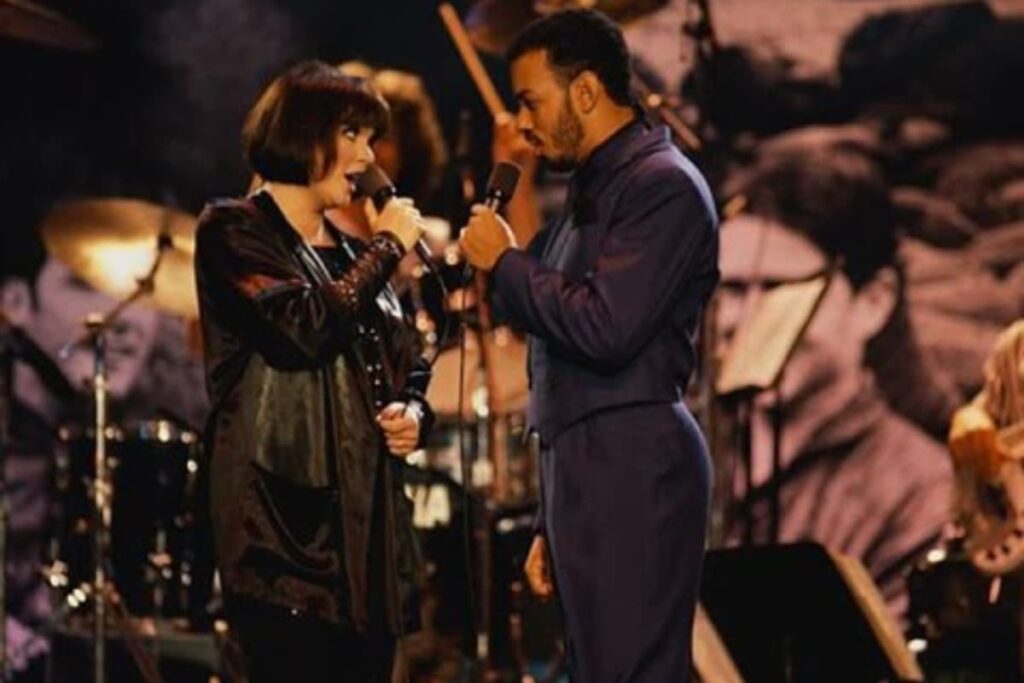
When “Somewhere Out There” ascended to No. 2 on the Billboard Hot 100 in early 1987, it did so not as a bombastic pop juggernaut, but as a tender invocation—an anthem of distance and devotion. Performed by Linda Ronstadt and James Ingram, the song appeared on the soundtrack to An American Tail, the animated film that gave its fragile melody a narrative home. It became one of the defining duets of the decade, earning Grammy Awards for Song of the Year and Best Song Written for a Motion Picture, and eventually securing its place in the canon of adult contemporary classics.
Written by Barry Mann, Cynthia Weil, and James Horner, the song is structured as a modern standard—simple in melodic contour, but expansive in emotional architecture. It opens in solitude, Ronstadt’s voice entering with a hush that feels almost confessional. “Somewhere out there, beneath the pale moonlight…” It is a line that situates us immediately in longing. The moon is not merely scenery; it is a shared witness, a silent emissary between separated souls. In the context of the film, it is sung by siblings torn apart by immigration, but in its broader cultural life, it has come to symbolize any love tested by geography, time, or fate.
Ronstadt and Ingram do not so much harmonize as converge. Ronstadt’s crystalline soprano carries a maternal warmth, while Ingram’s tenor, rich and resonant, provides grounding gravity. Their voices approach each other gradually, as if mirroring the song’s thematic arc—from isolation to union. When they finally meet in full duet, the effect is not explosive but enveloping. It feels like arms closing around absence.
Musically, James Horner’s composition leans into orchestral sweep without tipping into sentimentality. The key change in the final chorus is a classic pop device, but here it feels earned—a subtle lifting of the horizon. The arrangement underscores the lyric’s faith in unseen connection: strings swell like a rising tide of hope, and the rhythm remains steady, almost heartbeat-like, throughout. There is no percussive urgency. The tempo suggests patience.
What gives “Somewhere Out There” its enduring resonance is its refusal to dramatize pain. Instead, it sanctifies waiting. The lyric insists that love persists in the dark, that the same stars illuminate both sides of a divide. In the mid-1980s, amid a culture of glossy excess and neon bravado, this song stood as a quiet counterpoint—a reminder that vulnerability could still command the airwaves.
For Linda Ronstadt, already a titan of rock, country, and standards, and for James Ingram, whose smooth phrasing defined a generation of sophisticated soul, the duet became more than a soundtrack hit. It was a moment of convergence in their careers—a testament to the power of restraint, to the art of singing not over one another, but toward one another.
Nearly four decades later, the song endures not because it belongs to an animated film, but because it belongs to anyone who has ever looked up at the night sky and believed, against all odds, that someone else was looking back.