
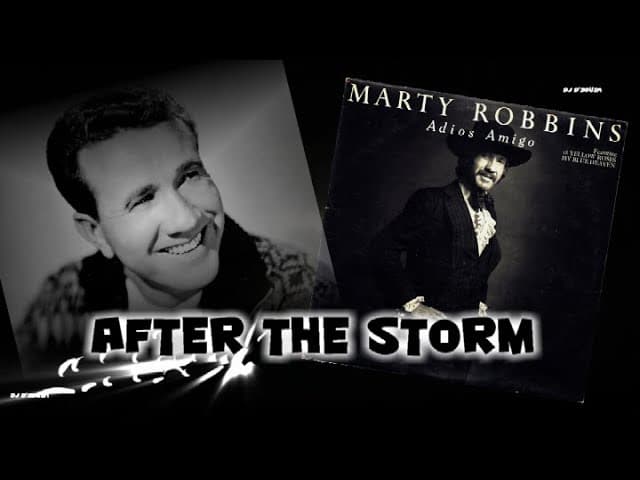
Meditation on endurance, where heartbreak passes like weather and resolve is the quiet horizon that remains.
Upon its release, After The Storm arrived during a period when Marty Robbins was a constant and authoritative presence on the country charts, benefiting from an audience already primed to trust his emotional compass. Issued within his prolific Columbia era and appearing on one of his studio albums rather than as a headline grabbing single, the song did not rely on chart spectacle to secure its place. Instead, it found its footing within the broader success of Robbins’ recorded work, carried by an artist whose albums consistently performed well and whose voice was already synonymous with narrative depth and emotional credibility.
What makes After The Storm endure is not any singular historical anecdote about its writing, but the way it distills Robbins’ artistic philosophy into a restrained and deeply humane statement. This is not a song about the drama of pain itself. It is about what follows, the quieter, more difficult work of standing upright once the damage has been done. Robbins sings with the authority of someone who has seen emotional weather come and go, shaping the lyric into a parable rather than a confession. The storm in question is never narrowly defined, and that ambiguity is deliberate. It allows heartbreak, loss, regret, and even moral failure to occupy the same symbolic space.
Musically, the song leans on the clarity that defined Robbins at his best. The arrangement avoids excess, favoring steady tempo and melodic patience. There is a sense of open space in the instrumentation, mirroring the emotional clearing suggested by the title. Robbins’ baritone does not plead or rage. It observes. That observational quality is essential to the song’s impact. He sounds like a man who understands that survival is not always triumphant. Sometimes it is simply calm.
Lyrically, After The Storm speaks to a worldview deeply rooted in country music’s postwar maturity. This is the voice of an artist addressing an audience that has lived long enough to know that pain is inevitable but not final. Robbins does not promise renewal in grand terms. There is no ecstatic rebirth here. Instead, there is acceptance, resilience, and a belief in emotional weather patterns. Storms arrive. Storms pass. What matters is the character revealed when the sky clears.
Within Marty Robbins’ catalog, the song occupies an important tonal space. While he is often celebrated for his cinematic ballads and narrative epics, After The Storm reminds the listener of his equal mastery of introspection. It reflects a cultural moment when country music increasingly spoke to adulthood rather than youthful yearning, offering listeners not escape, but companionship.
Decades on, the song resonates precisely because it refuses melodrama. It trusts the listener’s experience. In doing so, it becomes timeless. After The Storm does not ask to be remembered for where it placed on a chart. It asks only to be felt, quietly, by anyone who has waited for the weather to change and learned something in the waiting.